Nature
 PUBLISHED


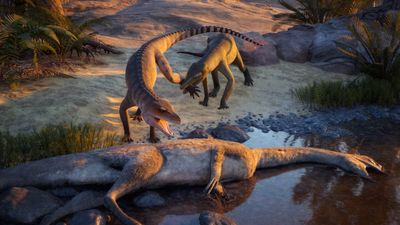


Researchers have categorized fossil remains from New Mexico as a new kind of early crocodylomorph, showing the ancestors and early relatives of crocodiles and alligators – about which we know relatively little – were a diverse bunch able to exploit a range of different diets.
The fossil was originally found at New Mexico's Ghost Ranch in 1948 and had been tentatively assigned to the known species Hesperosuchus agilis, but X-ray computed tomography (CT) scanning has now revealed it to be an entirely new animal the researchers are calling Eosphorosuchus lacrimosa.
PhD student Miranda Margulis-Ohnuma at Yale University revealed the robust bone structure of the animal's skull for the first time by digitally disassembling the CT scan. It's distinctive shape includes a prominent bony ridge running along the lower jaw, to which powerful biting muscles would have attached.
These features mark it out as distinct from H. agilis, but the two scaly creatures would have lived side by side. In fact, a fossil H. agilis was previously found just 5 meters (16 feet) away at the same site, which would have been a swampy floodplain 210 million years ago when these animals lived.
"During this period, the late Triassic, there were two reptile dynasties vying for dominance: the line that would produce crocodiles and alligators on one side, and that which would produce birds, which of course are dinosaurs, on the other," Bhart-Anjan Bhullar, also at Yale and senior author of the study, told Yale News.
"The dinosaurs at this time were slim, delicate animals that walked on two slender legs almost like herons, and the crocodiles were fast-running, four-legged predators, low-slung and more heavily built – analogous to a jackal, a big fox, or a dog."
A distinctive slit-shaped opening in front of the eye sockets gives the new crocodylomorph the appearance of crying, hence the species name lacrimosa, from the Latin for weeping.
The first part of its genus name, Eosphoros, is a Greek term for dawn, and it was picked because of the animal's early position in crocodiles' ancestral lineage, and in contrast to Hesperosuchus, whose name can be translated to mean evening.
The closeness of the two specimens and their anatomical differences suggest the two species lived alongside one another but exploited different ecological niches – indicating that these early crocodile relatives were already diversifying into a range of lifestyles and diets.
Adaptations for a stronger jaw are a known mechanism by which carnivores can branch out into exploiting new food sources. Similar adaptations can be found in modern-day hyenas, for example, which have some of the strongest bites among carnivorous mammals. This allows them to crush bones from scavenged kills and access the nutrient-rich marrow inside.
"Because early crocodylomorph fossils are relatively rare, every specimen contains important and novel information that is essential in untangling the early evolution", the researchers write.
The study is published in Proceedings of the Royal Society B: Biological Sciences.