


 Nature
 PUBLISHED



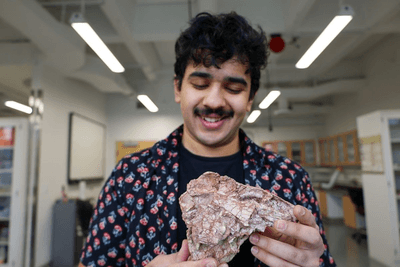


Since two academics started a program offering undergraduate students a chance to study distinctive fossil specimens, they’ve given rare opportunities to enthusiastic budding scientists. For Simba Srivastava, the specimen he got a chance to investigate turned out to be an aspiring palaeontologist’s dream, a long-neglected fossil that reveals much about the late Triassic ecosystem.
The significance of fossil discoveries isn’t always initially obvious, and many that aren’t in the best condition get filed away without proper analysis. Yet sometimes these oddities eventually shake up a field, or at least a niche. One such example is a skull found in 1982 at New Mexico’s Ghost Ranch. It sat neglected in a draw for more than 30 years until Stirling Nesbitt at Virginia Tech found it and suspected new technologies would now allow us to see the skull in ways its finders couldn’t.
Nesbitt’s department allows students to investigate neglected fossils like the one from Ghost Ranch, so it was assigned to Srinivastava, then a first-year student. “We want undergraduate researchers to experience the whole paleontological research process at Virginia Tech,” said Nesbitt in a statement. “Simba grabbed the project by the reins.”
Srivastava used CT scanning to print a 3D reconstruction of the damaged skull so it could be examined without needing to work around the original’s fragility. He identified the skull as belonging to a meat-eating dinosaur of a previously unknown species.
The strata in which the skull was found placed it in the late Triassic, when dinosaurs were still young and competing with a wide variety of other branches on the tree of life. It was only when they weathered the end-Triassic extinction better than their competitors that dinosaurs became the dominant life forms for 135 million years. “Dinosaurs go from being co-stars to the headliner,” Srivastava said, but his own evidence suggests they took some hits on the way.
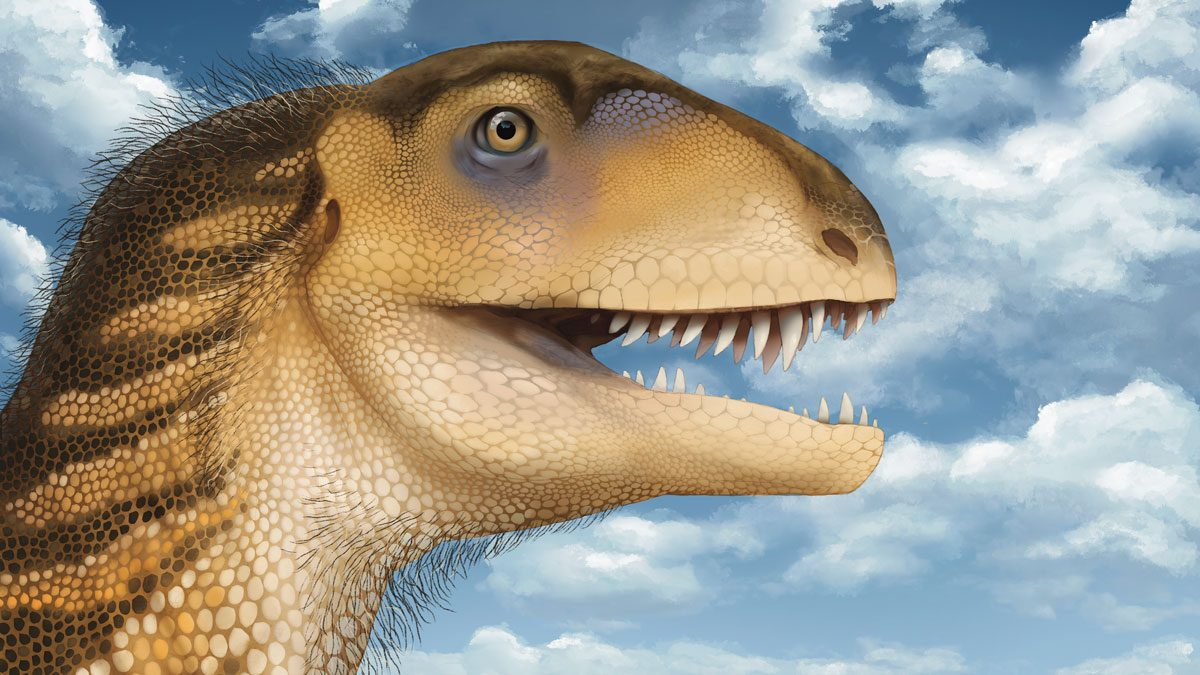
The specimen had enormous cheekbones and a wide braincase, but Srinivasan and his mentors think these were probably paired with a short snout. That’s not a combination that has been seen elsewhere among early dinosaurs, not only marking the fossil as a new species in need of a name but also showing that the dinosaurs of the day were diverse and evolving fast.
“We landed on Ptychotherates bucculentus, which means ‘folded hunter with full cheeks’ in Latin,” said Srivastava. “One paleo-artist said that it looked like a murder muppet.”
It took years of study, by which stage Srivastava was much further along with his degree, but the team has now concluded Ptychotherates is the youngest known member of the Herrerasauridae, a family of carnivorous dinosaurs, aside from one species with ambiguous ancestry from the same location.
One of the first carnivorous dinosaur families to evolve, whose best-known member is Tawa hallae, the earliest Herrerasauridae fossils were found in what is now Brazil, Argentina, Zimbabwe, and India, all of which were at high latitudes at the time. However, like some other dinosaur families, they were thought to have gone extinct by the late Triassic.
The rocks in which the find was made were deposited shortly before the end-Triassic extinction, suggesting Herrerasauridae made it to the end of the era, although perhaps only in a tropical refugium in the American southwest. The timing makes it likely that the mass extinction caused the end of the Herrerasauridae, rather than them having disappeared a fair while before, as was previously thought.
“This forces us to reconsider the impact of the end-Triassic extinction as something that wiped out not just the competitors to dinosaurs, but some long-standing dinosaur lineages themselves,” Srivastava said. He and Nesbitt propose that many dinosaur families that evolved at high latitudes survived in the late Triassic close to the equator, where New Mexico was at the time.
Srivastava likes to play with the fossil, asking Virginia Tech communications staff: “You want to stick your finger in a dinosaur brain?” Before telling them: “This is a uniquely sucky specimen. It's so bad. Like, if you saw a human skull in this way, you'd throw up.”
Yet that criticism sits alongside awe at the significance of what he worked on.
“This specimen, it fits in my hands, but it is the only proof that any of these dinosaurs lived this long, lived in these latitudes, the only proof that they evolved to have this skull shape,” said Srivastava. “All these billions of individuals that existed through time are spoken for by this one specimen.”
The study is published in Papers in Paleontology.



 1
1