Nature
 PUBLISHED





A fossil considered to be the oldest example of a land adapted vertebrate has turned out to be far more amphibious than had previously been recognized.
Although removing the reason this specimen was considered so special, it now has a different significance, and the conclusion demonstrates the power of new technologies to assist palaeontologists.
Say hello to Lizzie
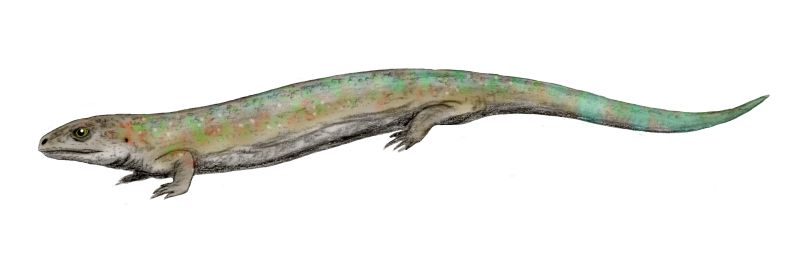
In 1990 a fossil found in Scotland was named Westlothiana lizziae, the genus name recognizing where it was found and the species name reflecting its lizard-like appearance.
Quickly nicknamed "Lizzie", Westlothiana was considered the oldest evidence of an amniote, the group that unites reptiles, mammals and birds, that was adapted to land. As such, it was plausible that Lizzie was, if not our direct ancestor, at least a member of the ancestral species that had plucked up the courage to leave the water behind.
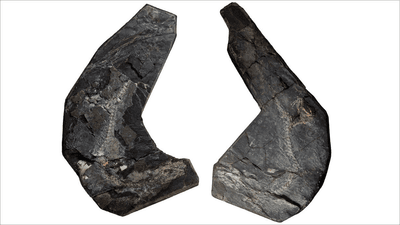
However, Lizzie lies within two crushed slabs of stone, and extracting the fossil would endanger the precious bones. This means that the initial assessment of Lizzie was only made based on the four limbs, including digits with claw-like tips, that can be seen at the surface.
That has now all changed.
Dr Xavier Jenkins, from the American Museum of Natural History (AMNH), and colleagues wanted to get a better look at the fossil. They decided to put Lizzie through a high-powered X-ray at the European Synchrotron Radiation Facility to create a 3D reconstruction, and it seems Lizzie needs a new name.
"Lizzie has been an icon for the early evolution of amniotes for decades," Jenkins said in a statement. "But when we were finally able to see inside the fossil, we found an animal that looked very different from what we expected."
Breathing underwater
Instead of looking lizard-like, the fossil formerly known as Lizzie has a fish-like mouth. It is filled with an astonishing number of miniscule teeth better suited to catching pretty in water, rather than on land, and a very un-reptilian-looking skull.
Most damningly at all is the presence of internal gills, suggesting Westlothiana spent enough time under water to benefit from extracting dissolved oxygen. If not fully aquatic, this was at least an amphibious species.
"The surprisingly primitive features of the skull show us that Lizzie was not only not a reptile but belonged to a much more ancient lineage," said Dr Ben Igielman, who worked on Westlothiana for his PhD at Oxford University.
"It turns out looks can be deceiving, and Lizzie lived a completely different lifestyle than we previously thought."
Disappointing as it may be that Westlothiana is not the ancestor of humans and dinosaurs alike, that doesn’t make the specimen unimportant.
The claws and foot structure that made the team that first used to described the fossil indicate these features evolved before tetrapods, or amniotes plus amphibians, left the water.
An even older ancestor
Instead of representing a reptile after the tetrapod family split between reptiles and amphibians, the authors argue that instead Westlothiana precedes that split. They've placed it as a sister species to Utaherpeton, which they call “an enigmatic Late Carboniferous taxon previously regarded as one of the earliest microsaurs.”
Indeed, they argue, many fossils previously thought to represent early amniotes more likely preceded the tetrapod family’s first great division.
"It shows that, although we think of amphibians as being more 'primitive' than reptiles today, some of the traits of reptiles were already there in the ancestor of both amphibians and reptiles,” said Professor Roger Benson, also from the AMNH.
Besides the claw-like features, these include the shape of the front limbs, which appear suited to bearing more weight than is necessary in water.
The authors point out that the reappraisal of Westlothiana has much wider implications, such as for how we interpret 359 million-year old fossil trackways found in Australia. These were made by a four-legged creature with claw-like digits, and had been taken as evidence amniotes existed at least this long ago.
Now, however, we know they could have been made by something Westlothiana-like, definitely tetrapodal, but not necessarily an amniote.
"The broader lesson is that terrestrial-looking traits, such as a reptile-like foot, a weight-bearing forelimb and claw-like phalanges, were not unique features of tetrapods, but rather accumulated piecemeal in their close relatives, in animals that were still living in and out of the water," Jenkins said.
Meanwhile, we may conclude that judging a still-encased fossil by its surface is as unwise as books by their covers.
The study is published in Nature


 1
1