Nature
 PUBLISHED



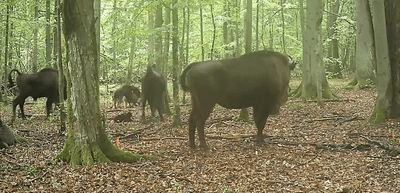


For the first time, wolves have been caught on camera hunting European bison in Białowieża Primaeval Forest. While no evidence of a “direct kill” was seen, the boisterous behavior suggests wolves have been successful elsewhere in Europe.
The intense inter-species brawl was captured on September 15, 2025, by scientists from the Polish Academy of Science using hidden camera traps deep in the Białowieża Primeval Forest, an ancient woodland on the border between Poland and Belarus where European bison were reintroduced in the 1950s.
Watch the hunt unfold
It kicked off at 7:25 am, just after the crack of dawn. The footage shows a pack of seven wolves targeting a herd of 11 European bison, consisting of five adult cows, two adult bulls, one subadult bull, and three juveniles, including a newborn calf.
Unsurprisingly, the wolves hone in on the most vulnerable, youngest member of the herd. However, in a remarkable display of instinct, the herd closes ranks around its youngest member, driving the wolves back.
When three bison cows broke away to chase the wolves, they inadvertently left the newborn exposed. The pack seized the moment, grabbing the calf by the neck and attempting to drag it away, before two adult cows charged in and drove them off.
The calf fled, but the wolves were dogged in their efforts, catching it a second time. Two adult bisons bore down on the pack with lowered horns while the rest closed in around the calf, forming a big, beefy shield.
Faced with this wall of mammalian muscle, the wolves abandon the attack. A few of the pack are seen lingering around the scene for a few moments, but they appear to have moved on by 7:47 am.
A first for Białowieża Primaeval Forest
Wolves are expert predators that can hunt prey up to 10 to 20 times their own body weight, including moose, elk, and bison. They achieve this through a combination of raw strength and endurance, plus a healthy dose of intelligence and – perhaps most importantly – teamwork.
They are known to hunt American bison in North America, which are a distinct species, but such interactions are far rarer in Europe, with only a handful of historical accounts on record.
“To our knowledge, we present the first video-recorded evidence of wolves attacking a European bison herd in the Białowieża Primaeval Forest, focusing on a newborn calf,” the study authors write.
“Although the video did not show a direct kill, our observation demonstrated that the European bison is in fact a potential prey for wolves,” they add.
This is what makes the new footage all the more significant. The European bison was driven to extinction in the wild in 1919 but was reintroduced into Białowieża Primaeval Forest in 1952. Fortunately, the researchers believe it’s unlikely that wolf predation is rampant enough to cause population decline.
More likely, this is just nature; wolves acting as a natural check to keep bison populations balanced within the ecosystem they now share.
The new study is published in the journal Ecology and Evolution.
This article was amended to more accurately reflect the researchers' expectations about the effect of wolf predation on bison populations in the present day.