Health and Medicine
 PUBLISHED
 3
3




It took a long time – and a deadly global pandemic – for mRNA vaccines to go from promising research curio to routine preventative medicine. Now, six years after proving its mettle to the tune of some 2.5 million lives saved, the same technology is taking on a more formidable foe: skin cancer.
And, rather thrillingly, it might be winning.
“For many years, the idea of creating an mRNA treatment designed specifically for an individual patient's cancer was aspirational,” said Stéphane Bancel, CEO of Moderna, in a statement released today. But, after years of research and clinical trials into an mRNA-based therapy for melanoma in partnership with fellow pharmaceutical company Merck, “we are now helping turn that vision into a reality,” Bancel announced.
It's certainly exciting news: according to the topline results of the companies’ new Phase 3 trial – that is, the final and most critical round of testing before a therapy is released onto the market – the new therapy cuts the risk of melanoma returning by almost half. The risk of the cancer spreading throughout the body, meanwhile, was reduced by almost three-fifths.
The full, detailed results will not be released until later this year, but still, these are not rookie numbers.
So is it as good as it sounds?
What’s the news?
Let’s rip the band-aid off straight away: if you’re basing your image of an “mRNA vaccine” for melanoma off of the shot you received for COVID, you’re going to be disappointed. For all that it may be being presented as the same thing, Moderna and Merck’s new therapy, dubbed intismeran autogene, is actually just one part of a multi-stage treatment, to be administered alongside surgery and immunotherapy.
For melanoma – one of the most common cancers, and certainly the most deadly type of skin cancer – that’s not really surprising.
Currently, the most likely course of treatment after surgery is likely to involve immunotherapy, which involves training the patient’s own immune system to recognize and destroy cancer cells more effectively on its own.
Like other cancer treatments, it has some pretty severe potential downsides: it can cause your body to attack itself; it can rev up your immune system, leaving you feeling like you’re fighting off the worst flu you ever experienced; for some unfortunate folks, it doesn’t work at all, and for others, it works only until their body gets too used to it.
Still, immunotherapy is more effective than other options, particularly for melanoma, and it’s often a helpful catalyst for other treatments too.
For melanomas, as well as a wide range of other cancers throughout the body, the current the standard of care is precisely this technology – specifically, the monoclonal antibody pembrolizumab, also known by its brand name Keytruda.
It was this drug that intismeran was being compared against, but not in a direct head-to-head battle. All the study participants were cancer patients with high-risk melanomas – people whose cancer was diagnosed stage 2b to stage 4, when survival rates start to drop pretty swiftly – and it would of course be unethical to deny them an established treatment.
Instead, as the standard treatment they would have received either way, Keytruda was administered to all patients involved in the trial – the difference was in whether they also received the mRNA treatment.
For 758 of the 1,137 participants in the study, the answer was “yes” – although they wouldn’t have known it, since the trial was randomized and double-blind, two criteria essential for any kind of meaningful results.
For everyone else, Keytruda and a placebo was administered. The whole thing took about a year – long enough for either the cancer to reappear, or, more optimistically, for the full course of nine doses to be administered.
And… well, it’s hard to argue with results. According to earlier data presented at the 2026 Annual Meeting of the American Society of Clinical Oncology back in May and June, using intismeran alongside Keytruda reduced a patient’s risk recurrence or death by 49 percent over those receiving Keytruda alone – which means, back-of-the-envelope math here, a reduction of two-thirds over no treatment at all.
The risk of distant metastasis, meanwhile, dropped by 59 percent, meaning the treatment was even better at containing the cancer to a smaller area of the body. It is overall, University of Florida pediatric oncologist Elias Sayour told the New York Times this week, “a big deal.”
“[These results] could help usher a whole new wave of new therapeutic treatments for cancer,” said Sayour, who was not involved in the trial. “Folks like myself in the community have been waiting for this.”
How does it work?
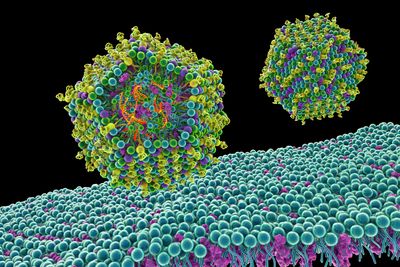
So, here’s where things get really cool. You may remember from the pandemic that mRNA vaccines work differently from their traditional cousins: rather than training your immune system to recognize a weakened or dead version of a disease – as, say, the MMR vaccine does – an mRNA vaccine instead delivers a set of instructions to our cells explaining how to fake it.
It’s like beating on a punching bag instead of an opponent in the boxing ring: either way, you get strong, but this way you’re not risking a punch in the face for the trouble.
It's only a short mental leap to apply that mechanism to cancer cells. The problem, though, is getting your body to recognize which cells to fight off – unlike, say, a strain of COVID, cancer is both a disease and also a part of you. A sick, mutated part, sure, but unique enough that some generic vaccine is simply not going to cut it.
So, intismeran works differently – and in a way that sounds more science fiction than soon-to-be fact: “the mRNA vaccine is tailored for single individuals using the genetic blueprint of their individual tumour,” explained Associate Professor Seth Cheetham, Deputy Director of the BASE mRNA Facility at The University of Queensland, to the Australian Science Media Centre. “[It] helps immune cells better recognise and eradicate cancer cells.”
It's technically called an mRNA-based individualized neoantigen therapy, and, like bounty hunters scanning a “wanted” poster, intismeran works by training the immune system to target only mutations found on an individual’s tumor cells.
“While previous personalised medicines match patients to the right drug, this is the first to create an entirely new drug for each patient,” pointed out Cheetham. “The trial represents a landmark in personalised cancer medicine and is the start of a wave of new studies to bring this technology to patients with other diverse types of cancer.”
That’s no wishful thinking. Melanoma may be the cancer that’s making the headlines today, but there are a host of other, similar trials currently ongoing for various tumor types.
Merck and Moderna themselves are currently performing several in non-small cell lung cancer patients, with earlier-stage trials in patients with bladder, kidney, pancreatic, and stomach cancers – results for those, Moderna President Stephen Hoge told Reuters, should start to emerge next year.
“The positive hit here leads us into truly this next phase in immunotherapy,” Karen Knudsen, CEO of the Parker Institute for Cancer Immunotherapy, told CNN this week. “This is an auspicious start – this is where things begin.”
The cost of rejection
As exciting as all this is, it’s hard to overlook the context in which it arises.
Only last year, US Health Secretary and self-proclaimed vaccine skeptic Robert F. Kennedy, Jr. pulled dozens of research contracts, totaling hundreds of millions of dollars, into mRNA vaccine development, citing in a statement his belief – one totally contradicted by actual scientific consensus – that they “fail to protect effectively against upper respiratory infections like COVID and flu.”
But this week’s news shows just how important it is to follow real, peer-reviewed and clinically trialled evidence. mRNA vaccines aren’t just a curio that happened to work for COVID – increasingly, it’s becoming clear that this technology has the potential to revolutionize how we cope with some of humanity’s longest-standing and most tenacious medical enemies.
“These Phase 3 findings represent a pivotal moment for the field of cancer research,” said Bancel. “Together with Merck, we have started to demonstrate the transformative potential of this technology to address critical unmet needs in the adjuvant melanoma setting.”
“We are deeply grateful to the patients, investigators and study teams whose contributions make this progress possible.”