Space and Physics
 PUBLISHED



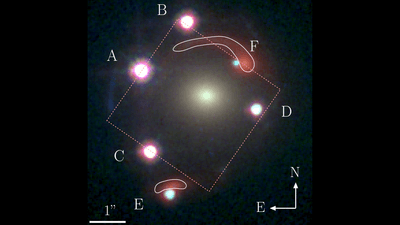


A major realization of Einstein’s general relativity is the fact that massive objects warp space-time in a way that is similar to a lens, magnifying and shifting the light of background objects. This was a crucial test for relativity just four years after it was proposed, and it has been seen in countless examples. Today, 105 years after the first test, astronomers continue to discover never-seen-before alignments. Meet the zig-zag lens.
All gravitational lenses are exciting, but some are more exciting than others. At first glance, J1721+8842 was intriguing, but it wasn’t particularly revolutionary. In this system, the light of a distant quasar traveled more than 10.5 billion years to reach us. Passing through a lens, it formed six visible images. The number six was unique, which made it interesting, the authors of the paper (which has yet to complete peer review) explain. In recent years, there was a proposal that six images could form under particular conditions – that is, having two lenses.
The first lens is relatively close to the source, with a distance estimated at 10.2 billion light-years. What happens is that the quasar’s light is magnified and multiplied by this massive galaxy. Two of the images are deflected in the opposite direction as they reach the second lens, another massive galaxy. The path of the light is a zig-zag between the quasar, the first lens, and then the second one, which is just 2.3 billion light-years away.
Not only that, but the second lens also magnifies the first – though not very bright, it can be seen in the images collected by JWST. The team believes this to be the first case of a double gravitational lens and the first example of a galaxy-scale strong gravitational lens with six images of the same distant object.
This is a serendipitous and extraordinary find. The researchers were curious what was the chance of finding such a precise alignment between us, two lenses, and a quasar on a single line of sight stretching over 10.5 billion light-years. They estimate it is one in 100 million.
If this was not enough, this object seems to be a cornucopia of excitement. It is the northernmost gravitational lens known, which means there are a lot of ground-based telescopes that can conduct follow-up observations. Its peculiar nature could also be used to better estimate the expansion rate of the universe – a current topic of heated debate in cosmology.
The paper is currently awaiting peer review from Astronomy & Astrophysics, and is currently available on the ArXiv.

 1
1