Space and Physics
 PUBLISHED





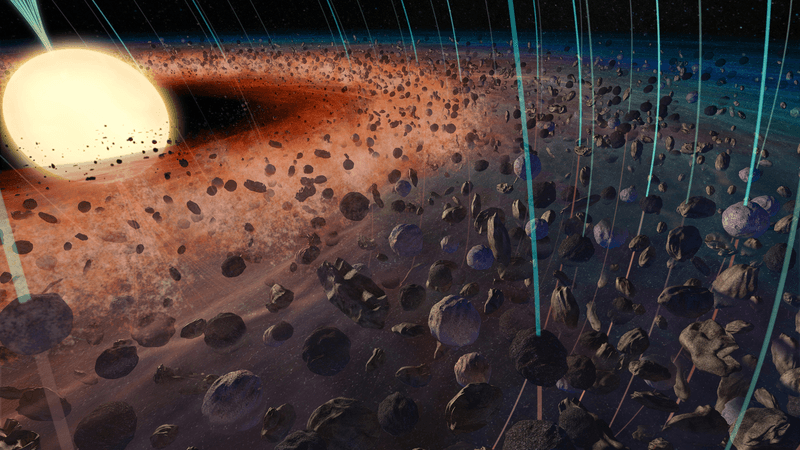
An international team of astronomers have been able to probe the atmosphere of an exoplanet like never before. Exoplanet Tylos, also known as WASP 121-b, is an ultra-hot Jupiter – a gas giant so close to its stars that one year lasts only 30 hours. This proximity allowed researchers to probe the atmosphere like never before, being able to map it in three dimensions.
The planet is tidally locked to its star, which means one side is always facing it and, for that reason, has a scorching temperature. The side in everlasting night (which might have a rain of ruby and sapphires) is much cooler, but the weather actually helps mix up the temperatures. And that’s not all.
“This planet’s atmosphere behaves in ways that challenge our understanding of how weather works – not just on Earth, but on all planets. It feels like something out of science fiction,” lead author Julia Victoria Seidel, a researcher at the European Southern Observatory (ESO) in Chile, said in a statement.
Researchers were able to determine that the deepest layer has a wind of iron that blows away from the location where the star is at midday towards the edges of the day-side. Above it, there is a very fast jet of sodium, going around faster than the planet rotates but in the same direction, and on top a layer of hydrogen is lost to space that overlaps with the sodium jet below it.

“What we found was surprising: a jet stream rotates material around the planet’s equator, while a separate flow at lower levels of the atmosphere moves gas from the hot side to the cooler side. This kind of climate has never been seen before on any planet,” added Seidel, who is also a researcher at the Lagrange Laboratory, part of the Observatoire de la Côte d'Azur, in France.
The jet stream, spanning half of the planet, can speed up and violently shake the atmosphere’s highest layers as it moves through Tylos’s day-side.
“Even the strongest hurricanes in the Solar System seem calm in comparison,” Seidel explained.
The researchers were able to study the motion and composition of the atmosphere using the ESPRESSO instrument on the European Southern Observatory’s Very Large Telescope. Beyond the hydrogen, sodium, and iron, they also found titanium below the jet stream layer. This has not been seen before, probably because the titanium was hiding so deep in the planet’s atmosphere.
“It’s truly mind-blowing that we’re able to study details like the chemical makeup and weather patterns of a planet at such a vast distance,” says Bibiana Prinoth, a PhD student at Lund University, Sweden, and ESO, who led a companion study and co-authored the main study.
The planet is 900 light-years away. The team suggests that when the Extremely Large Telescope comes online in a few years, they’ll be able to see these weather patterns on even smaller Earth-like planets.
The study is published in the journal Nature.