Space and Physics
 PUBLISHED




Magnetars are some of the most extreme objects in the universe. A special class of neutron stars, they are celestial bodies that pack the mass of the Sun in a sphere the size of a city. On top of that, magnetars have a magnetic field so powerful that if there was one halfway to the Moon, it would wipe out every credit card on Earth. Their formation has been an object of debate, but new observations confirm the lead hypothesis: they are the product of incredibly bright supernovae.
Superluminous supernovae are about 10 or more times brighter than the average stellar death explosion. They were only discovered in this century and have been very puzzling. They were believed to be the product of massive stars of about 25 times the mass of our Sun. That’s the top range for neutron star formation. Heavier stars are likely to turn into black holes.
There was something weird about these superluminous supernovae, though. They stayed glowing for longer than the theoretical model suggested. In 2010, theoretical astrophysicist Dan Kasen and Lars Bildsten, and independently, Stanford Woosley of UC Santa Cruz, proposed that a magnetar might power that longer-lasting glow, as well gifting the produced neutron star with a formidable magnetic field, 100 to 1,000 times stronger than pulsars, the rapidly spinning neutron stars.
Observations of supernova SN 2024afav by graduate researcher Joseph Farah of UC Santa Barbara and Las Cumbres Observatory showed the light of a superluminous supernova has a distinct bump, which they call a chirp.
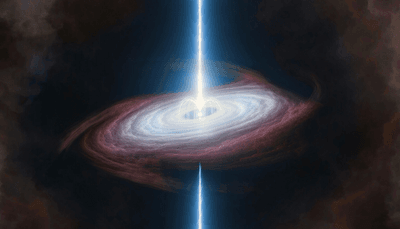
During the supernova explosion, some of the material will be compressed into the magnetar, while most of the rest will be thrown out. Still, the pull of the magnetar is such that some escaping material ends up in an accretion disk deep within the supernova. The misalignment between the incredible magnetar and this disk would produce very specific signals according to general relativity, producing emission of light that would look like the chirps.
"This is the most exciting thing I have ever had the privilege to be a part of. This is the science I dreamed of as a kid," Farah said in a statement. "It's the universe telling us out loud and in our face that we don't fully understand it yet, and challenging us to explain it."
The work doesn’t claim that all superluminous supernovae are powered by magnetars, but some of them are likely to be.
"What's really exciting is that this is definitive evidence for a magnetar forming as the result of a superluminous supernova core collapse," explained Alex Filippenko, a UC Berkeley distinguished professor of astronomy who is a co-author of the paper and one of Farah's soon-to-be mentors.
"The basis of Dan Kasen and Stan Woosley's model is that all you need is the energy of the magnetar deep within and a good fraction of it will get absorbed, and that'll explain why the thing is superluminous. What had not been demonstrated was that a magnetar did, in fact, form in the middle of the supernova, and that's what Joseph's paper shows."
"For years, the magnetar idea has felt almost like a theorist's magic trick—hiding a powerful engine behind layers of supernova debris. It was a natural explanation for the extraordinary brightness of these explosions, but we couldn't see it directly," Kasen added.
"The chirp in this supernova signal is like that engine pulling back the curtain and revealing that it's really there."
The study is published in the journal Nature.