Space and Physics
 PUBLISHED
 1
1





Yesterday, we saw amazing observations of a full halo coronal mass ejection release from the Sun, passing over comet C/2023 A3 Tsuchinshan-ATLAS, and continuing straight for Earth. It will slam into our planet in a matter of hours.
Coronal mass ejections (CMEs) are stupendous releases of high-speed plasma from the Sun. They are associated with solar flares, and just this week we had multiple flares causing radio blackouts. Among them, there was the most powerful flare of this solar cycle so far. This CME appears to be the fastest measured during solar cycle 25.
“It is a very speedy CME. It's the fastest CME that we've really measured that had a total Earth-directed component in the solar cycle thus far,” Shawn Dahl, a forecaster and coordinator at NOAA's Space Weather Prediction Center, said during a media briefing.
.gif "Animation showing the comet coming into view. The comet is a bright strip of light slowing coming into focus. the Sun is cover by the coronagraph and it is releasing wispy arcs of plasma, the cmes")
The current estimate is for a severe geomagnetic storm, possibly not as strong as what we saw in May – that assessment was raised to extreme as the multiple CMEs at that time slammed into our planet’s magnetosphere.
While the predictions are based on our best understanding, the Space Weather Prediction Center stresses that the crucial data will come from the satellites located about 1.5 million kilometers (about 1 million miles) between the Earth and the Sun. The data will inform better predictions for space weather about 30 minutes before the CME hits us.
During geomagnetic storms telecommunications can be disrupted and so can the standard operations of satellites, which might affect things like maps as well as other apps (banking, for example, uses a surprising amount of space stuff). It can also create affect electrical transformers. That’s why the current predictions and the more precise ones that will be released in a few hours are important.
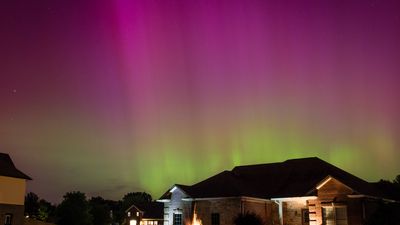
Obviously, big geomagnetic storms also mean auroral activity. The expectation is for some strong events – maybe not as dramatic as what we had the opportunity to see in May, but predictions, as we have seen, can change until the last minute. In Europe, it will cover all of Scandinavia and should be visible low on the horizon in Scotland and the northern portion of Ireland.
Given that the magnetic North is towards the Americas, it will reach lower latitudes there. It could be seen all over Canada and it may be visible low on the horizon in Seattle, Des Moines, Chicago, Cleveland, and Boston. In the Southern Hemisphere, the South Island of New Zealand and Tasmania would be the places to be.