Space and Physics
 PUBLISHED





Fast radio bursts (FRBs) are incredible releases of energy – as much as the Sun releases in days – that last for a fraction of a second. Only very few have been tracked down to their sources and their actual origin continues to be uncertain. Astronomers have now been able to track an FRB to the literal outskirts of its celestial source.
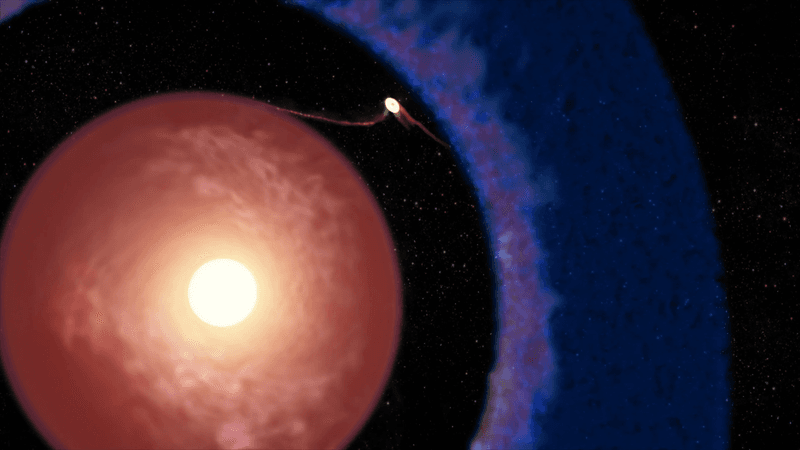
Researchers have estimated that FRB 20221022A exploded from a region that is at most 10,000 kilometers (6,000 miles) away from a neutron star. A neutron star in a galaxy 200 million light-years away. Or to give it better context: a galaxy that is 1,892,000,000,000,000,000,000 kilometers (1.176×10²¹ miles) away.
The unbelievably close range suggests that the incredible magnetic field of the neutron star is creating the FRB. Certain neutron stars have prodigious magnetic strength (they are called magnetars), so strong that it was actually uncertain whether the release of energy could happen – things might have been all too tightly bound.
“In these environments of neutron stars, the magnetic fields are really at the limits of what the universe can produce,” lead author Kenzie Nimmo, a postdoc in MIT’s Kavli Institute for Astrophysics and Space Research, said in a statement. “There’s been a lot of debate about whether this bright radio emission could even escape from that extreme plasma.”
“Around these highly magnetic neutron stars, also known as magnetars, atoms can’t exist – they would just get torn apart by the magnetic fields,” says Kiyoshi Masui, associate professor of physics at MIT. “The exciting thing here is, we find that the energy stored in those magnetic fields, close to the source, is twisting and reconfiguring such that it can be released as radio waves that we can see halfway across the universe.”
To distinguish between a scenario where the burst came from the magnetosphere or from further out, the team used a phenomenon known as scintillation. Basically, depending on how much plasma it has to traverse, a signal will twinkle. But FRB 20221022A also had another special property: its light was polarized, meaning that the radio waves were all oscillating in the same direction.
To add to the perfect storm of optimal conditions, the gas in the host galaxy of FRB 20221022A was also responsible for some of the scintillation, which actually helped the team because it magnified the original signal, allowing them to follow it to such a tiny region around the neutron star.
“This means that the FRB is probably within hundreds of thousands of kilometers from the source,” Nimmo said. “That’s very close. For comparison, we would expect the signal would be more than tens of millions of kilometers away if it originated from a shockwave, and we would see no scintillation at all.”
“Zooming in to a 10,000-kilometer region, from a distance of 200 million light-years, is like being able to measure the width of a DNA helix, which is about 2 nanometers wide, on the surface of the moon,” Masui said. “There’s an amazing range of scales involved.”
The study is published in Nature, along with a companion study on the polarization.