Space and Physics
 PUBLISHED





In the galaxy next door lies an intriguing nebula we call Tarantula. Inside, stars have been born and have died for millions of years. The closest supernova in the last 50 years comes from its outskirts, Supernova 1987A. But another supernova remnant in this nebula has caught the eye of the researchers lately: 30 Doradus B. Because it doesn’t really make sense.
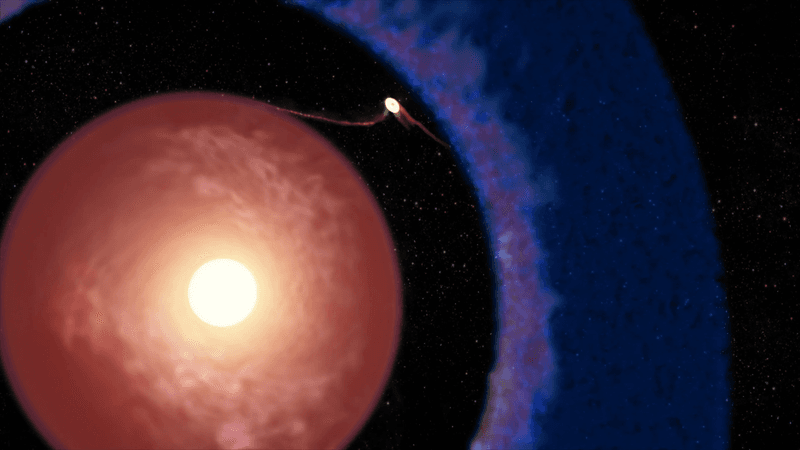
Astronomers were studying the pulsar PSR J0537-6910 and its surrounding area in a variety of wavelengths. Pulsars are a type of neutron star, which release jets of material that at regular intervals are shot towards us. Neutron stars are one of the possible end products of supernovae, for stars that are massive enough to end up exploding but not so massive that they form a black hole.
Pulsars are extremely energetic objects releasing light across multiple wavelengths from X-rays to radio. So studying a supernova remnant across these different types of light provides a lot of insights – until things break apart, and we get even more.
By using the pulsar's properties, such as how quickly it is slowing down, they estimated the supernova happened 5,000 years ago. Using NASA’s Chandra telescope, which looks at the universe in X-rays, astronomers were able to follow the stream of energetic particles from the pulsar. This creates a pulsar wind nebula. They also found a halo of X-rays, a common feature in supernovae, centered around the pulsar region. But this halo is just too big to have formed within the last five millennia. It extends for over 130 light-years.
So researchers suspect that another supernova took place in the vicinity earlier than 5,000 years ago, resulting in the structures that are witnessed in the observations. The requirement is at least two supernovae, but the faint diffuse X-ray halo might suggest that the region has experienced a string of supernovae over the cosmically recent time. The region around 30 Doradus B has been forming stars nonstop for at least 8 million years, maybe up to 10 million years.
It’s the whole Tarantula Nebula that is an indefatigable star-making factory. Located in the Large Magellanic Cloud, 160,000 light-years away, it is brighter than many stars in our galaxy. The whole region is so bright that if it were located at the distance of the Orion Nebula it could cast visible shadows (light pollution permitting).
The nebula was also recently snapped by JWST creating a magnificent composition.
The study is published in The Astronomical Journal.