Nature
 PUBLISHED


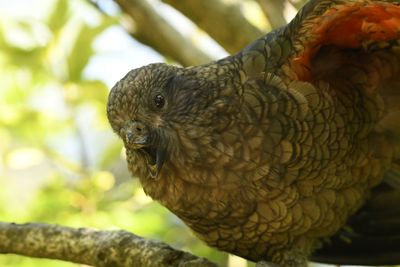


Disabled animals often require more care, and can struggle in wild or semi-wild settings. However, for Bruce the kea, a parrot living in a wildlife reserve in New Zealand, he’s proved that only having half a beak is no barrier to success, having invented a totally new way to win dominance battles.
Kea (Nestor notabilis) are large parrots endemic to New Zealand that are known for their intelligence and curiosity. Bruce, who's the subject of a new study, arrived at Willowbank Wildlife Reserve 12 years prior to the observations carried out during the research, and was already missing his upper beak. However, that doesn’t seem to have stopped him from becoming the ringmaster of his circus, the collective noun for a group of keas.
The team behind the study observed 227 conflict interactions within Bruce’s circus of 12 kea – consisting of three females and nine males, including Bruce – over a 4-week time frame. There were 162 male-male conflict interactions during this time, which the team used to find out the dominance rank of each of the males. Bruce ranked first and won all of his 36 conflicts.
The researchers then compared the ranking to the presence of stress hormones in the kea's droppings. Bruce had the lowest levels, while two subordinate kea called Taz and Johnny had the highest.
The question of how Bruce has achieved dominance over the other males becomes pretty clear when his fighting style is observed. Bruce has a jousting style of fighting where he thrusts his lower beak forwards, sometimes combining it with a run or a jump. This allows Bruce to distribute more of his attacks across a wider range of the opponent's body.
Kea with intact beaks were found to bite downwards onto necks, which made up 67 percent of their beak attacks, while Bruce struck the back, head, wings and legs of his opponents. Both Bruce and his rivals kicked each other the same amount, but Bruce used his beak much more, displacing his rivals 73 percent of the time.
“Bruce's jousting made him so successful because his 11 peers haven't yet figured out how to counter the diverse lower beak motion and cannot replicate it,” first author Alexander Grabham told IFLScience.
As well as being king of the combat ring, Bruce showed his social dominance in other ways. He was preened by a range of non-mate birds, the only parrot to receive this attention. He was allopreened by Taz, the lowest ranking male on nine occasions, by Megatron four times, Joker also four times, and Neo twice. The researchers think that this could be why Bruce has the lowest stress hormones, since allopreening is associated with reduced stress. Bruce has already been found to be able to preen himself using his beak or other tools.
“Bruce won all of his fights alone, does not require assistance to eat, and can clean his own lower beak and feathers. But he does sometimes solicit and receive cleaning of his lower beak and head feathers. A perk of dominance, rather than a necessity,” said Grabham.
Bruce also had priority access to the four feeding stations and was the first to arrive on any of them 83 percent of the time, and was never challenged by another bird while feeding.
“Bruce demonstrates that, in captive environments, innovative compensation for impairment is possible outside of primates, and without coalition networks,” explain the authors of the paper.
Despite his lack of intact beak, Bruce is able to be the dominant male of the group, and win fights very successfully. Kea intelligence has allowed Bruce to adapt to his impairment and thrive by creating a novel behavior that helps him beat his rivals. This is the first example of a disabled animal that can maintain alpha status without help and solely through behavioral innovation.
“Kea intelligence and behavioural complexity provide ideal building blocks for innovation. Bruce's life carried on after he lost his upper beak, and at some point, those building blocks helped him figure out what works,” explained Grabham. “Bruce is often met with pity at Willowbank, solely due to his appearance. Even a severe impairment does not have to mean an animal won't succeed.”
The study is published in Current Biology.