Space and Physics
 PUBLISHED




Despite controversy, human remains are on their way to the Moon today, after Space burial firm Celestis, which promises to launch the remains of loved ones into space, purchased space on board private firm Astrobotic's Peregrine lunar lander.
The mission has been criticized by the Navajo Nation (amongst others) for ignoring the sacred position the Moon has in many indigenous cultures, with the President of the Navajo Nation describing it as a “desecration of this sacred space.”
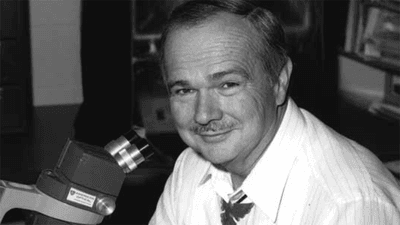
Surprisingly, though this is not the first commercial mission to place remains on the lunar surface; there are already human remains "buried" on the Moon. They belong to Eugene Shoemaker, whose ashes were launched to his final resting place by Celestis on January 6, 1998. Twenty-eight grams (1 ounce) of Shoemaker's ashes were sent on board NASA's Lunar Prospector, inside a small vacuum-sealed polycarbonate capsule.
Around the capsule was a passage from William Shakespeare's Romeo and Juliet, reading:
And, when he shall die,Take him and cut him out in little stars,And he will make the face of heaven so fineThat all the world will be in love with night,And pay no worship to the garish sun.
So why are his remains there? Shoemaker, very much resisting nominative determinism, was a planetary legendary geologist. His career included selecting and training Apollo astronauts in lunar geology and impact cratering, leading NASA's search for water at the lunar poles, and co-discovering Comet Shoemaker-Levy, the first directly observed object to slam into Jupiter in 1994.
After training Apollo astronauts, Shoemaker went on to work on the Voyager mission, as well as NASA's Clementine mission to find water on the Moon. He became the first director of the United States Geological Survey's Astrogeology Research Program.
As impressive as his contributions to these projects were, Shoemaker had always had other ambitions, including being an astronaut, which he could not pursue due to being diagnosed with Addison's disease.
"It was legend in the planetary science community that Gene had always wanted to go to the Moon as an Apollo astronaut and study its geology firsthand," Carolyn C. Porco, a student and colleague of Shoemaker told NASA following his death in a car accident in 1994. Porco decided to ask NASA if her former boss could be sent to the Moon after his cremation, after getting the family's approval, of course.
"He said only last year, 'Not going to the Moon and banging on it with my own hammer has been the biggest disappointment in life.' I felt that this was Gene's last chance to get to the Moon, and that it would be a fitting and beautiful tribute to a man who was a towering figure and a pioneer in the exploration of the Solar System," she said.
Remarkably, and as a testament to NASA's respect for Shoemaker, the space agency said yes to the mission, crashing his ashes and burying them on the lunar surface.
"I don't think Gene ever dreamed his ashes would go to the Moon," his wife Carolyn told NASA shortly before the launch. "He would be thrilled."
"This is so important to us," she added. "It brings a little closure, in a way, to our feelings. We will always know when we look at the Moon, that Gene is there."
Celestis's second Luna Memorial Flight, named Tranquility, is currently traveling on the Peregrine mission carrying a capsule with the remains and DNA of 66 mission "participants". It is due to land in the northeastern part of the Moon on February 23 and will remain there permanently.