Space and Physics
 PUBLISHED
 2
2




With over half a century since NASA last landed astronauts on the Moon, it's pretty exciting that the space agency will soon be returning to it with the upcoming Artemis missions. Before the crewed launch (fingers tightly crossed) in November 2024, NASA will return to the Moon, hitching a lift aboard a private company's lander on January 25.
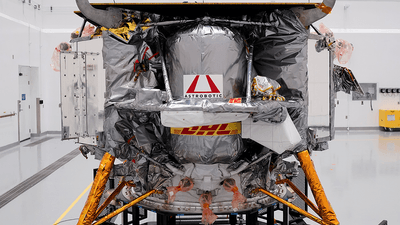
The mission, run by American space company Astrobotic, will carry NASA instruments to the lunar landscape, to study it ahead of the space agency's planned landings. Onboard the Peregrine lander will be 21 payloads from NASA, governments, universities, and companies, from seven different countries.
Among NASA's payloads is a Neutron Spectrometer System, which will look for signs of water-ice near the lunar surface, examining the composition of the soil, and a Linear Energy Transfer Spectrometer, which will collect information about radioactivity at the lunar surface. A more annoying payload, funded by a cryptocurrency company, will be a single bitcoin loaded into a physical coin emblazoned with the logo.
While there, the company is hoping to guarantee 10 days of working time for the instruments, before the long lunar night will likely stop them functioning.
“It’s incredible to realize that we are just a short time away from our Peregrine spacecraft beginning its journey to the Moon,” John Thornton, CEO of Astrobotic, said in a press release. “After years of dedication and hard work, we are so close to having our moonshot. We invite you to follow along as Peregrine, with seven countries represented aboard, launches to the Moon and attempts one of the first successful landings of an American spacecraft since Apollo.”
As well as an exciting day, for some the launch will be a funeral. Space burial firm Celestis, which promises to launch the remains of loved ones into space, have purchased space on board the lander.
The Peregrine lunar lander has now been delivered safely to Cape Canaveral, Florida, ahead of the launch date of December 24, 2023.
“As we know, space is a difficult environment. We’re ready for launch after successfully completing a battery of industry-standard acceptance testing so Peregrine has the best chance for mission success,” Sharad Bhaskaran, Astrobotic’s Peregrine Mission One Director, said.
“Peregrine and the team are ready. After launch, we will separate from the Vulcan Centaur and establish power and communications with the spacecraft to guide it to the Moon. Then, we will attempt a historic autonomous landing on the lunar surface.”