Nature
 PUBLISHED
 2
2


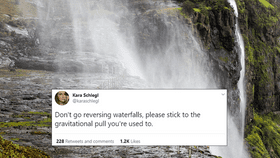


Strong storms and torrential rain in Australia recently have caused one of nature’s stranger phenomenons to appear in Sydney: a “reverse waterfall”.
Winds of up to 74 kilometers an hour (46 miles per hour) have battered the New South Wales coast this week, quite literally pushing streams of water and sea spray back up a cliff face and over the top in Royal National Park.
Amazingly, the spectacular scenes were captured on video, showing not only the waterfall blowing straight back up over the cliff and into the air but the rainbow it creates as it sprays upwards.
The aerial footage shows two waterfalls along the coastal path near Bundeena in the Royal National Park, south of Sydney. The protected park is famous for its stunning clifftop views featuring waterfalls that flow off the edge of the sandstone cliffs straight into the ocean. Some of these cliffs reach 100 meters (328 feet) high, so that's quite a drop.
Reverse waterfalls occur when high winds come off the ocean and hit the cliffs, forcing the waterfall back up the cliff face. New South Wales has certainly experienced some strong winds this week, with extreme thunderstorms, gale-force winds, and torrential rain leading Australia's Bureau of Meteorology to issue two flood evacuation orders on Monday while thousands have been left without power.
It wasn't just at Royal National Park the upside-down waterfalls were raging, footage captured by Anthony Clark and shared on Twitter showed strong upwards streams and spray at Kurnell in the southern area of Sydney's Kamay Botany Bay National Park too.
Though reverse waterfalls are not a new phenomenon, having been spotted at the Rjúkandi Waterfall in Iceland, Amboli in India, and the Peak District in the UK, those who didn't know they existed before now are taking this as the latest example of the wild ride that is 2020.