Nature
 PUBLISHED


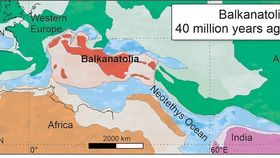


Around 50 million years ago, an ancient continent dubbed Balkanatolia sat between Europe and Asia, and was home to an array of interesting species that were unlike those found on either neighboring landmass. Proposing the existence of this long-lost realm, the authors of a new study suggest that falling sea levels allowed Asian mammals to enter Balkanatolia and replace the local wildlife, before moving on to Western Europe and triggering a sudden extinction event.
Known as the Grande Coupure, this dramatic loss of European fauna occurred some 34 million years ago at the end of the Eocene epoch. However, presenting their research in the journal Earth-Science Reviews, the study authors explain that Asian species begin to appear in the fossil records in southeastern Europe some five to ten million years prior to this event.
To fill in the gaps in the timeline leading up to the Grande Coupure, the researchers reviewed all 31 Eocene mammalian fossil records from the Balkan peninsula and Anatolia, reassessing the date of some of these finds based on updated geological data. Their results indicated that throughout much of the epoch, the region existed as “a previously unrecognized biogeographic province, designated here as Balkanatolia.”
However, the fossil record also showed that Asian rodents and four-legged hoofed animals – or ungulates – had colonized the area by around 40 million years ago. Among the Asian species that had invaded Balkanatolia before the end of the Eocene were brontotheres, which resembled large rhinoceroses but became extinct around the time of the Grande Coupure.
“This colonization event was facilitated by a drop in global eustatic sea level and a tectonically-driven sea retreat in eastern Anatolia and the Lesser Caucasus during the late middle Eocene,” write the study authors.
It wasn’t until 34 million years ago, when a glaciation event caused sea levels to lower once again, that Balkanatolia became connected to Western Europe via a land bridge. This paved the way for Asian mammals to continue their journey westward and trigger the demise of numerous European species.
In other words, the researchers suggest that major geographical changes occurring 40 and 34 million years ago enabled Asian ungulates and rodents to colonize Europe in two stages. In the first of these, they took up residence in Balkanatolia itself, where they replaced much of the existing wildlife before later continuing their conquest of the European continent.
“These paleogeographic changes instigated the demise of Balkanatolia as a distinct biogeographic province and paved the way for the dispersal of Asian endemic clades before and during the Grande Coupure in western Europe,” conclude the authors.