Space and Physics
 PUBLISHED



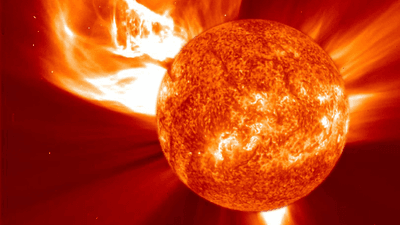


Solar storms can be scary. They have the ability to disrupt our tech, cause blackouts, and even impact us directly. Still, nothing directly observed nor in living memory might quite compare with new findings from researchers – a peak of radiation, consistent with an extreme solar particle event (ESPE) more intense than anything previously known on record.
The most intense event on record is the January 20, 2005, solar storm. If you were on a plane over the southern polar regions (which received a good chunk of that radiation), you’d have received the typical annual cosmic radiation dosage at sea level in just one hour. If you were on a plane in 12350 BCE, you’d have received the annual dosage of radiation in less than 8 seconds.
“Compared to the largest event of the modern satellite era — the 2005 particle storm — the ancient 12350 BC event was over 500 times more intense, according to our estimates,” lead author Dr Kseniia Golubenko, from the University of Oulu in Finland, said in a statement.
The famous Carrington event, the most powerful on record, was not accompanied by a solar particle storm, so it is difficult to compare the two. There is a different comparison that was fundamental for this work: the 775 CE event, which was also very powerful.
The evidence for both comes from tree rings, but for this older event, researchers had to contend with the complexity of estimating tree rings under glacial conditions. To do this, they developed a new climate chemistry model, SOCOL:14C-Ex, and validated it with other known events. With this model, they estimated that the 12350 BCE event was 18 percent more intense than the 775 CE event.
“The ancient event in 12350 BC is the only known extreme solar particle event outside of the Holocene epoch, the past ~12,000 years of stable warm climate,” added Golubenko. “Our new model lifts the existing limitation to the Holocene and extends our ability to analyse radiocarbon data even for glacial climate conditions.”
It is possible for the Sun to create a superflare event, some simplistic early models suggest, based on other sun-like stars, with a possible occurrence rate of maybe one every 6,000 years. Could those two events be the measured effects of a superflare? More work is needed to find out.
“This event establishes a new worst-case scenario,” Golubenko noted. “Understanding its scale is critical for evaluating the risks posed by future solar storms to modern infrastructure like satellites, power grids, and communication systems.”
The study is published in the journal Earth and Planetary Science Letters.