Space and Physics
 PUBLISHED
 2
2


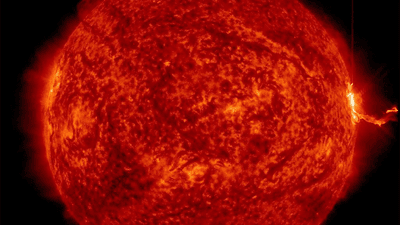


The strongest solar flare of 2025 so far has been unleashed by the Sun, causing radio blackouts over southeast Asia, Europe, and the Middle East.
The Sun had quite an active year in 2024, sending plenty of solar storms our way as we headed to the peak of the Solar Cycle. But our star is not done quite yet, and has hurled another strong solar flare into the Solar System from sunspot region 4087.
In terms of magnitude, the solar flare was classed as an X2.7 flare. The smallest of flares are B-class, followed by C, M, and the strongest category, X, while the numbers following the letter also denote strength within that category.
"Similar to the Richter scale for earthquakes, each letter represents a ten-fold increase in energy output. So an X is 10 times an M and 100 times a C," NASA's Scientific Visualization Studio explains.
"C-class flares are too weak to noticeably affect Earth. M-class flares can cause brief radio blackouts at the poles and minor radiation storms that might endanger astronauts. Although X is the last letter, there are flares more than 10 times the power of an X1, so X-class flares can go higher than 9."
Sunspot region 4087 unleashed a smaller flare yesterday, though it was still notably large at category X1.2, causing a brief shortwave radio blackout in the Americas, according to SpaceWeather.com. That flare was associated with a coronal mass ejection (CME), large expulsions of plasma and magnetic field from the Sun's corona. It is also responsible for accelerating energetic protons to rain down on Earth's atmosphere, triggering a low S1-class radiation storm warning. At this level, there is no risk to biological life, though radio can be affected.
The coronal material from that ejection is unlikely to hit Earth, with NASA models expecting it to hit Mercury and graze Venus. However, an M-class solar flare occurred shortly afterwards, and part of this could collide with Earth, potentially bringing aurora with it.
The X2.7 flare, released at 08:25 AM UTC on May 14, is not expected to have produced a CME that will collide with Earth, according to the NOAA Space Weather Prediction Center.
"Flares of this magnitude are not frequent," they note, adding "users of high frequency (HF) radio signals may experience temporary degradation or complete loss of signal on much of the sunlit side of Earth."
While astronomers can provide a warning for CMEs, as the material can take a few hours to several days to make its way to our planet, flares travel at the speed of light, and so we only observe them as their effects hit the Earth. This can include interference with radio waves.
"The increased level of X-ray and extreme ultraviolet (EUV) radiation results in ionization in the lower layers of the ionosphere on the sunlit side of Earth," the Space Weather Prediction Center explains.
"Under normal conditions, high frequency (HF) radio waves are able to support communication over long distances by refraction via the upper layers of the ionosphere. When a strong enough solar flare occurs, ionization is produced in the lower, more dense layers of the ionosphere (the D-layer), and radio waves that interact with electrons in layers lose energy due to the more frequent collisions that occur in the higher density environment of the D-layer. This can cause HF radio signals to become degraded or completely absorbed. This results in a radio blackout – the absence of HF communication, primarily impacting the 3 to 30 MHz band."
AR4087 may release more solar flares and CMEs over the coming days, with a chance that the Earth could be caught in the firing line as it rotates into view.