Nature
 PUBLISHED


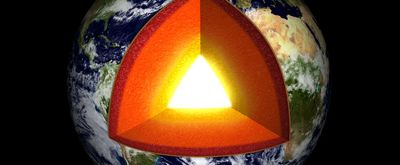


Sunken slabs from long-lost tectonic plates are still churning around in Earth's interior, far below your feet. In a new study, geologists have attempted to map the base of the mantle, close to where it meets the planet's core, and found that these subducted slabs may be having a far greater impact than previously realized.
Despite how it appears to the human eye, planet Earth is not an unchanging, solid ball of rock. It's better imagined as a multi-layered bundle of clay, parts of which can shift and deform over vast spans of time. This is most clearly seen at the surface in the super-slow-motion drift of continents, but there's also significant movement deep below the crust in the mantle, the chunky body of rocky material that makes up much of Earth's volume.
In the new study, researchers from the University of California and Arizona State University sought to get a clearer look at these unseen dynamics by sampling nearly 75 percent of the lowest mantle layer, just above the core-mantle boundary around 2,900 kilometers (1,800 miles) below the surface.
They achieved this feat by collecting and analyzing data from more than 16 million seismograms, involving 24 data centers around the world.
The data revealed a phenomenon known as seismic anisotropy, variations in the speed of seismic waves, rippling through parts of the lower mantle. While models had predicted this might occur, the team found evidence of it across two-thirds of the lower mantle area they sampled.
“We know that deformation in the upper mantle is dominated by the drag of the plates that move across it. And that extremely well approximates what we know from seismic anisotropy about the deformation of the upper mantle,” Jonathan Wolf, lead study author from the University of California, Berkeley, said in a statement. “But we don’t have any of this kind of large-scale understanding for flow in the lowermost mantle. And that’s really what we want to get at.”
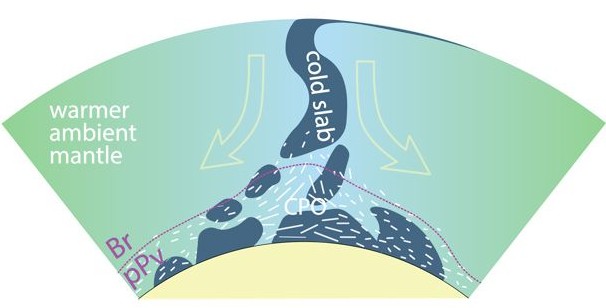
Much of the movement in the mantle is driven by convection, the lava lamp-like circulation of rock caused by heat radiating from the core toward the surface. However, other factors also appear to be at play. The data showed that most of the anisotropy occurs in locations where scientists believe dense pieces of oceanic lithosphere have sunk deep into the mantle at convergent plate boundaries, forming what are known as subducted slabs.
As the slabs descended into the warm interior, they deform and displace material under intense pressure and heat. This behaviour, the researchers suggest, appears to have some direct link to the anisotropic patterns they observed.
"This isn't that surprising in a sense, because that is predicted by geodynamic simulations. But at the scale that we're looking at, it's not really been shown using those methods that we're using,” explained Wolf.
However, there are still many unknowns about the inner workings of our planet. The deepest humans have ever drilled into the Earth is 12.26 kilometers (7.6 miles) – quite literally a scratch on the surface of a vast globe. The vast majority of what science knows about Earth's interior comes from remote sensing rather than direct observation, meaning our picture of these deep processes is still frustratingly incomplete.
“If I can dream, we will someday have enough information to really say much more about global flow directions of the lowermost mantle, knowing the seismic anisotropy across different lateral scales in the mantle, illuminating it from many directions,” said Wolf.
The study is published in The Seismic Record.

 1
1