Space and Physics
 PUBLISHED
 1
1





Have you come across those recipes that suggest a wild substitution for a pretty standard dish? Well, astronomers might have found the celestial equivalent of that. What’s even more bizarre is that while you do need eggs, flour, and milk to make pancakes, you can make cosmic dust without silicon.
Silicon is a crucial element when we consider the rocky planet we are standing on. It is the second most abundant element in Earth’s crust, after oxygen. It ends up making planets because it is a crucial component of cosmic dust, and the very reasonable assumption was that without silicon, you cannot have these solid dust particles. The universe seems to hate it when we have reasonable assumptions.
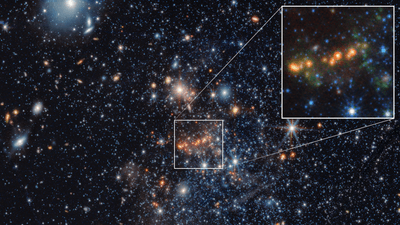
Researchers used JWST to look at a close but primitive dwarf galaxy called Sextans A. It is only 4 million light-years away, but it is extremely poor in heavier elements, a quality known as metallicity. The system has a metallicity of just 3 to 7 percent of that of the Sun, meaning that it is overwhelmingly made of hydrogen and helium.
Heavier elements than those are created in stellar processes and then spread as stars age or go supernova. This is how galaxies became enriched. It's what happens in galaxies like the Milky Way. But Sextans A is a small galaxy, and its weak gravitational pull means a good chunk of this enriched material has been lost.
For this reason, this galaxy looks like a primordial one, even though it is close in age to ours. With JWST, researchers looked at asymptotic giant branch (AGB) stars, a phase where stars with masses between one and eight times that of the Sun become massively inflated.
“One of these stars is on the high-mass end of the AGB range, and stars like this usually produce silicate dust. However, at such low metallicity, we expect these stars to be nearly dust-free,” Martha Boyer, associate astronomer at the Space Telescope Science Institute and lead author of one of the two papers, said in a statement.
Somehow, even without silicon, this star was surrounded by dust. The dust grains were made almost entirely of iron. This has never been seen before in stars that are analogous to the stars common in the early universe. These observations suggest that we might be missing something pretty important in the formative ages of the cosmos.
“Dust in the early universe may have looked very different from the silicate grains we see today,” Boyer added.
It is not just dust made of iron. The observations also revealed the presence of particular organic molecules known as polycyclic aromatic hydrocarbons (PAHs). These, too, are found in cosmic dust. They are made of carbon and are the smallest dust grains that can be seen glowing in infrared. Sextans A is the lowest-metallicity galaxy ever found to contain PAHs.
“Sextans A is giving us a blueprint for the first dusty galaxies,” the other paper's lead author, Elizabeth Tarantino, a postdoctoral researcher at the Space Telescope Science Institute, added.
The first paper is published in The Astrophysical Journal. The second paper is under review and has been posted to the arXiv.
The results were presented at the 247th meeting of the American Astronomical Society in Phoenix, Arizona.