Ad

space-iconSpace and Physics
clock-iconPUBLISHEDMay 16, 2025
share91

Mesmerizing Cosmic Dust Rainbow Caught By NASA's PUNCH Mission

The mission to study the Sun’s influence on the Solar System has released its first images.

Dr. Alfredo Carpineti headshot

Dr. Alfredo Carpineti

Alfredo has a PhD in Astrophysics and a Master's in Quantum Fields and Fundamental Forces from Imperial College London.

Space & Physics Editor

Alfredo has a PhD in Astrophysics and a Master's in Quantum Fields and Fundamental Forces from Imperial College London.View full profile

Alfredo has a PhD in Astrophysics and a Master's in Quantum Fields and Fundamental Forces from Imperial College London.

View full profile
EditedbyHolly Large
Holly Large headshot

Holly Large

Copy Editor & Staff Writer

Holly has a degree in Medical Biochemistry from the University of Leicester. Her scientific interests include genomics, personalized medicine, and bioethics.

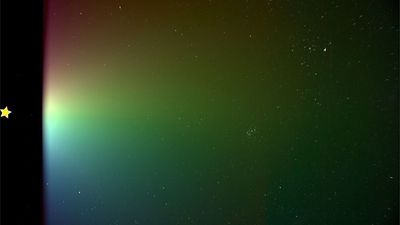
On April 18, 2025, the WFI-2 instrument (which captured its first light on April 14) took images through all three of its polarizers in succession for the first time to create this view. The image is colorized to show the polarization (or angle) of the zodiacal light, a faint glow from dust orbiting the Sun. Hue indicates direction, and saturation indicates degree of polarization. For example, a pastel green feature would be slightly polarized in the horizontal direction, while a deep blue feature would be strongly polarized in a diagonal direction. The Sun’s location is marked with a star symbol. Other stars in the sky appear white because they are mostly unpolarized compared to the 7% polarization of the zodiacal light. The compact Pleiades star cluster appears just above center, and the V-shaped Hyades star cluster appears to the upper left of the Pleiades.

The rainbow here tells us some deep secrets about the interaction of sunlight with interstellar dust. 

Image credit: NASA/SwRI


Where does the Sun end and the Solar System begin? The answer is not clear-cut. The Sun’s atmosphere – the corona – extends far into space, and its processes shape the solar wind that streams in interplanetary space, affecting planets, moons, and more. To better study these interactions, NASA launched a mission made up of four spacecraft, and now, some of their glorious first images are here.

The rest of this article is behind a paywall. Please sign in or subscribe to access the full content.

The mission has a Narrow Field Imager (NFI) and three Wide Field Imagers (WFIs). The NFI snaps pictures of the corona around the Sun using an occulter, which blocks the light of the Sun. This approach is useful as long as you don’t want to see too close to the Sun, because as you can see in the picture below, sunlight will diffract on it, creating those beautiful rings of stray light.
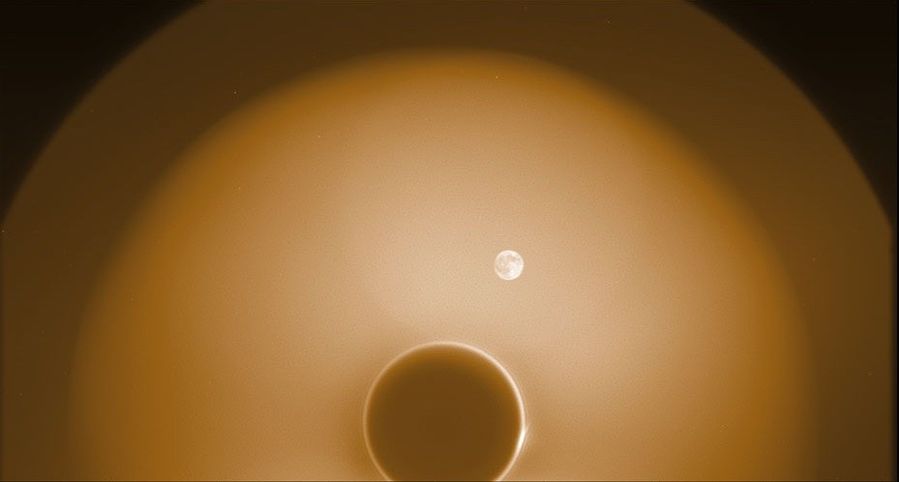
During commissioning, PUNCH’s NFI instrument captured this image of the new Moon as it passed by the Sun in the sky on April 27, 2025. The new Moon appears full, because it is illuminated by Earthshine (sunlight reflected off Earth). The image helped the PUNCH team confirm that the Moon will not obscure NFI’s view of the corona and solar wind. The dark circle near the bottom is the shadow of NFI’s occulter, which hides the Sun. The occulter, which was not yet fully aligned with the Sun, is surrounded by a narrow bright ring of diffracted light. Around that is a large, hazy circle of stray light glinting off the occulter (the Moon is inside that circle). Outside that is a small, dimmer region of the sky that is less affected by glint.
NFI image of the solar corona with the Moon.
Image credit: NASA/SwRI

Other missions are happening to see closer to the Sun; there’s Proba-3 from the European Space Agency, where two spacecraft align so that the one in front can be the occulter, delivering an eclipse on demand. But truly, solar eclipses are the best for it – so you either wait to have one or you plan a mission that can deliver them monthly by following the Moon in special orbits.

And talking about the Moon, it is a bit odd to see it so clear in the above photo. That picture was taken during the new Moon phase, where the near side, the side we see, is experiencing night. The reason why we can see it is due to Earthshine, sunlight reflected by our planet and illuminating the Moon’s shadowed surface.

The WFIs are instead looking away from the Sun and into the plane of the Solar System, providing the second side of the understanding sought by this two-year mission. What they are looking at is the zodiacal light. This is created by dust that is spread around the Solar System, though mostly across its plane, catching sunlight. Interestingly, zodiacal light was also the research topic of Dr Brian May’s thesis; he took a 36-year-long break before completing it because he became somewhat busy with his band, Queen.
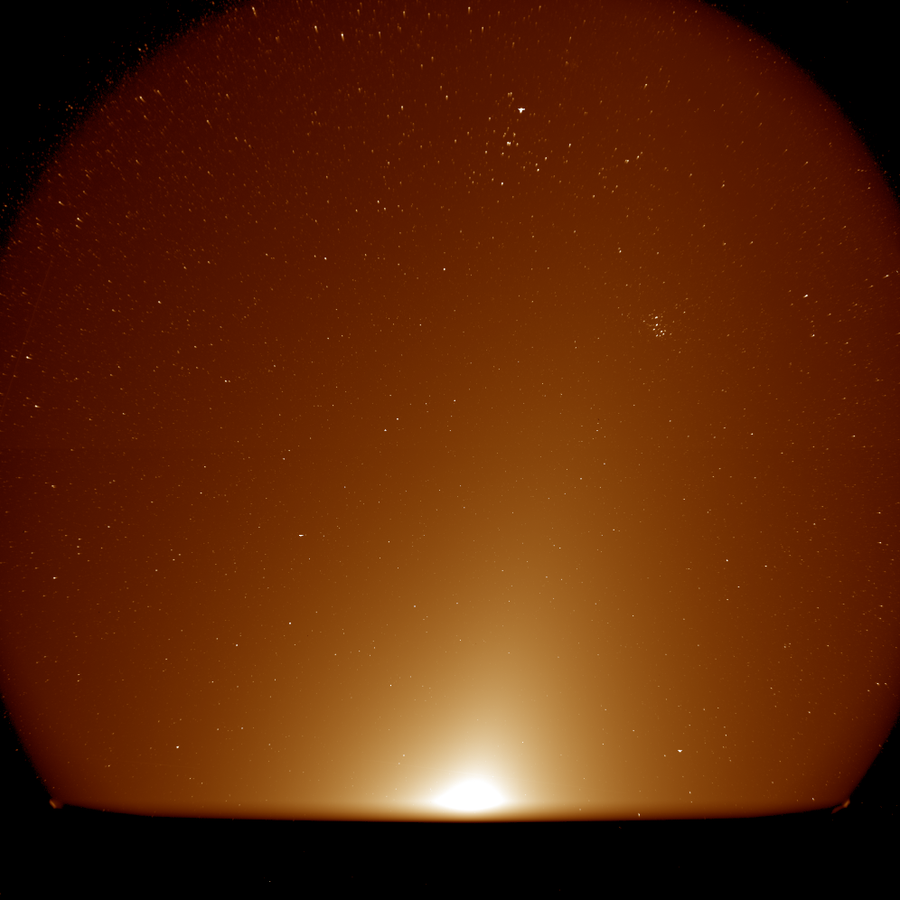
The instrument’s wide field of view reveals the glow of zodiacal light stretching up and to the right. The V shape of the Hyades star cluster appears near the top, with the more compact Pleiades star cluster to the lower right.
The zodiacal light appears like a false dawn, creating the illusion of the sunrise. It is just sunlight bouncing off dust.
Image credit: NASA/SwRI

The different instruments are studying the zodiacal light in slightly different ways to build a 3D picture of interplanetary space to work out how the coronal structures turn into the solar wind, as well as how explosive events such as coronal mass ejections then propagate through interplanetary space. The prettiest of all pictures is, of course, the rainbow one from WFI-2.

The colors are not real but are placed on it for scientific reasons. The colors are related to the polarization of light, the angle at which the light waves oscillate. The hue of the color is used to indicate direction, while the saturation is the intensity.  “A pastel green feature would be slightly polarized in the horizontal direction, while a deep blue feature would be strongly polarized in a diagonal direction,” NASA explained in a statement.

The mission will be very important to understanding the Sun and its impact, and it adds to the array of new spacecraft and telescopes that can now observe our star like never before.

Add us as a Google preferred source to see more of our
trusted coverage in Search