Nature
 PUBLISHED
 2
2




What you’ll discover in this article
- Tracks of what appears to be the largest mammal of the dinosaur era have been found in Brazil.
- The maker is thought to have been twice as large as any previously known mammal from the Cretaceous and could have hunted dinosaurs.
- Dr Hermínio Ismael de Araújo-Júnior told IFLScience, “The traditional expectation that Mesozoic mammaliaforms were predominantly very small could potentially influence how unusually large tracks or fragmentary fossils are interpreted.”
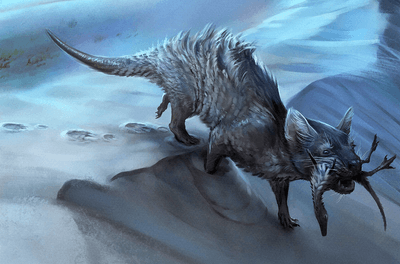
Footprints found in the Botucatu Formation, Brazil, have a shape consistent with being made by mammals’ paws, not dinosaurs’ feet. Yet the mammal that made these would need to have been much larger than any previously found, or even suspected, from before the asteroid impact reshaped the world. It seems the picture we have of our ancestors skulking beneath terrifying giant reptiles may need reworking: something this big could have hunted quite substantial dinosaurs.
Rodents Of Unusual Size
It’s a story told a million times: our mammalian ancestors were small creatures comparable to modern shrews or squirrels that battled to avoid becoming meals for dinosaurs, until a giant space rock upended everything. True, there’s evidence that some mammals preyed on dinosaurs, but this was thought to include only the smallest members of the clade, comparable to modern birds.
In 2017, two papers reported rather larger mammals, named Aracoaraichnium leonardii and Brasilichnium anaiti, respectively. These creatures were probably the size of small dogs or large house cats. The newly reported footprints take things a great deal further, suggesting a beast similar in size to a large dog, or possibly even a mountain lion, roaming around 130 million years ago..
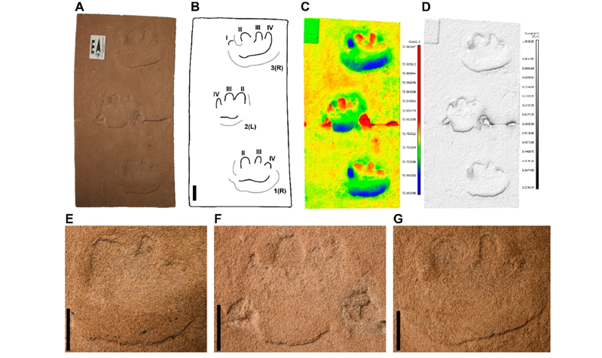
The prints vary somewhat in size, but the largest are 11.4 centimeters (4.5 Inches) long and 13.4 centimeters (5.4 Inches) wide. That ratio is one of the features that makes Dr Hermínio Ismael de Araújo-Júnior and co-authors think these were made by mammals, not dinosaurs. The spacing is consistent with a stride length of around 40 centimeters (16 inches).
Footprints can be very revealing, but there is always a lot of information we cannot know without skeletal fossils, or ideally a skull. Moreover, the authors acknowledge, “In the Botucatu Formation, most vertebrate tracks are preserved under conditions of low substrate cohesion, which commonly results in simplified morphologies and partial loss of fine anatomical detail.”
Nevertheless, they think there is enough there to make some educated guesses. The prints look much like larger versions of those from many mammals, and unlike anything attributed to a dinosaur or crocodile.
The authors think the trackmaker was at least twice the size of the previous largest dinosaur-era mammal, probably around 1.55 meters (5 feet) long, based on comparisons with species where we have both bones and prints.
The authors have opted not to give a name to the maker of the tracks yet, but assign it to the Chelichnopodidae family of mammal footprints.
Filling a niche
Although this is far beyond other known mammals of the day, the authors note that the previous two candidates for record holder were found in the same formation. It seems then that something about the ecosystem the Botucatu Formation preserves allowed mammals to grow much larger than elsewhere at the time.
Exactly what this was remains unknown. However, first author Dr Pedro Buck told Science that larger dinosaurs might have been missing in this desert region for unknown reasons, allowing mammals to fill some extra niches.
Although placed in what is now lush Brazil, at the time this site lay in a giant desert, far from any coastline. When Gondwana broke up, most of the Formation became part of South America, with a small area isolated in Africa.
Brasilichnium, in particular, was widespread across the Formation, including at the site of the new prints, suggesting the desert offered opportunities for relatively large mammals to flourish.
Missing pieces
Naturally paleontologists are keen to find some bones from this relative giant, but they’re not optimistic.
“This is actually one of the most intriguing aspects of our discovery,” de Araújo Júnior told IFLScience.
“No mammaliaform body fossils are currently known from Jurassic or Early Cretaceous rocks in Brazil, and the Early Cretaceous skeletal record of mammaliaforms in Gondwana as a whole is extremely scarce. This makes the Botucatu tracks particularly important: They reveal animals that are simply absent from the Brazilian skeletal fossil record.”
The Botucatu Formation is a vast desert environment, and the same conditions that preserved footprints may not have been the best for preserving bones, de Araújo Júnior pointed out.
“The best prospects may be deposits representing more favorable local environments within, or temporally close to, this ecosystem, where carcasses had a greater chance of being buried and preserved,” he said.
On the other hand, “we should certainly keep an open mind” about the possibility that other large mammal specimens, be they footprints or bones, have already been found, he told IFLScience.
“The traditional expectation that Mesozoic mammaliaforms were predominantly very small could potentially influence how unusually large tracks or fragmentary fossils are interpreted,” he said. Some items may have been left uncategorized, because no one could believe they came from a mammal that big at that time.
The tracks alone cannot reveal a diet in the way teeth or jaws might, but the authors think their maker was an omnivore that “may have occasionally preyed upon juvenile or small-bodied dinosaurs.”
It probably also ate smaller mammals, invertebrates, and whatever else it could get its paws on, although plants were probably a small proportion of the diet at most. If you're the largest mammal to live alongside the dinosaurs, why settle for anything less.
The study is published in the Journal of South American Earth Sciences.