Nature
 PUBLISHED



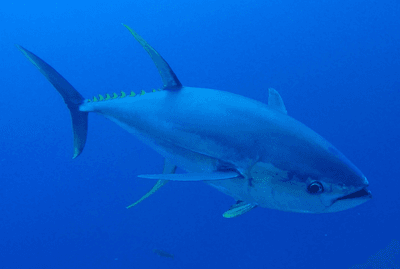


Think of a warm-blooded animal. You're probably picturing a cow or a dog, maybe an elephant. But how about a tuna?
Warm-bloodedness, or endothermy, is rare among the 33,000 species of fish, but tuna belong to a select few that can hold onto the heat generated by their muscles. This increases their efficiency and allows them to maintain a high cruising speed across massive distances.
In our rush to explain how every single biological trait evolved, we biologists have resorted to Just So Stories for how they originated.
Chase Brownstein
Tuna belong to a fish family called the Scombridae. These predatory fish started making waves around the same time as the extinction of the dinosaurs 66 million years ago, and account for about half of all endothermic ray-finned fishes.
The story goes that the ancient relatives of these fish became warm-blooded – and also started growing to larger sizes – as they took over ecological roles that used to be occupied by large Cretaceous fishes and marine reptiles that had been wiped out by the asteroid.
What does an asteroid have to do with tuna?
A new study, however, argues that this timeline doesn't add up – and, more than that, that it's a case of wrongly ascribing simple reasons to the evolution of complex traits.
"In our rush to explain how every single biological trait evolved, we biologists have resorted to Just So Stories for how they originated," Chase Brownstein at Yale University told IFLScience.
"Just because a trait has a particular function, it does not mean the trait evolved because of that function. Evolution is blind, and so traits assemble in many different ways and can secondarily be harnessed for new functions."
Brownstein's team obtained genetic sequence data from 50 species in the Scombrid family and used this alongside evidence from the fossil record to construct a family tree of how tuna and their relatives – which include mackerel and bonito – evolved.
In some ways, the team's findings align with what other researchers thought was the case, putting the origin of Scombrids at roughly 68 million years ago near the end of the Cretaceous.
However, rather than rapidly diversifying and developing traits like endothermy and massive size, the new tree has the family diversifying over a protracted period spanning the following 40 million years.
In particular, they propose that endothermy evolved independently three times in Scombridae lineages, with at least two of these occurring 10-to-15 million years after the asteroid strike.
The researchers also found that increases in body size appear to have occurred sporadically in Scombrids over the past 50 million years, with tuna only reaching their gigantic size within the past 10 million years.
Evolved for one thing, used for something else
Brownstein says this is evidence that the evolution of large body size and warm-bloodedness were decoupled both from each other and from the asteroid strike.
Unless I am out of the know, no biologist has a time machine we can use to go back 56 million years.
Chase Brownstein
This would mean that while Scombrids clearly flourished and took advantage of the extinction of Cretaceous-era fishes, that event wasn't what drove them to become large warm-blooded predators.
While large body size and warm-bloodedness do work together to improve the fish's abilities to migrate long distances, dive deep, and become efficient predators, Brownstein thinks may be an example of "exaptive" traits. This is when a trait initially evolves for one function then shifts to be useful for another.
Are whales to thank for tuna, instead?
But the asteroid strike isn't the only reason put forward for how warm-bloodedness evolved in Scombrids. Another hypothesis holds that it has to do with evolving to compete with, or find ways to escape from, whales and dolphins, known as cetaceans. These were also beginning to make their mark on the fossil record at the time.
Brownstein is dismissive of ascribing this reason to the traits' evolution too, saying "frankly, it's just made up."
"Unless I am out of the know, no biologist has a time machine we can use to go back 56 million years to observe how outcompeted tunas were by whales," says Brownstein. "You simply cannot substantiate claims about these systems without an extremely complete fossil record, and even then it is difficult."
Dahiana Arcila at the University of California, San Diego, a proponent of the cetacean hypothesis, isn't so sure. Brownstein's results still place the origin of endothermy in the Eocene, she noted, which is when cetaceans were diversifying. So in this case, the timing does line up.
For that reason, she sees the new results as a finer-grained look at the evolution of endothermy in Scombrids specifically, which is not in conflict with their results.
Her group also examined over 1,051 species of fishes across a broad range of families, drawing on evidence from the fossil record, the diets and geographic distributions of both fishes and cetaceans during the Eocene, and used a statistical model to test their interactions. She contends that dismissing the hypothesis as “made up” isn't a scientific rebuttal.
“It’s a hypothesis supported by multiple lines of evidence, an established line of reasoning and is consistent with the timing," says Arcila. "The relevant question is not whether the inference is experimental, but whether it is supported by evidence. Ours is."
Arcila and Fernando Melendez Vazquez at UC San Diego both cite the evolution of warm-bloodedness in mammal ancestors during the Triassic, when there was an arms race between them and the ancestors of dinosaurs, as a supporting case where these kinds of interaction are also thought to have driven the evolution of warm-bloodedness.
"Macroevolution is not amenable to experimental manipulation, so every claim here rests on inference," says Arcila. "That cuts both ways."
"If a coincidence in timing cannot by itself show that interactions with cetaceans shaped the origin of endothermy, then a decoupling in timing, recovered within a single young family and from divergence dates alone, cannot by itself argue against it."
The study is published in the Proceedings of the Royal Society B, Biological.