Nature
 PUBLISHED
 1
1


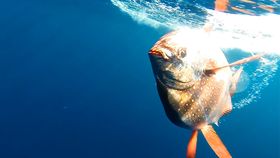


Scientists have found three more species of a fish that – despite what we are taught at school – are fully warm-blooded. The species in question are large deep-sea fish known as opah, and are found in many oceans around the planet.
A few years ago, the opah made headlines when it was revealed to be the first fully warm-blooded fish species ever discovered. Living in the frigid waters of the deep ocean, it warms its blood by continuously flapping its fins to generate heat.
This keeps the fish’s core temperature at about 5°C (9°F) warmer than the water and is maintained through a counter-current heat exchange system, in which the warm blood from the body heats the cool blood returning from the gills. This is remarkably similar to what is seen in more traditionally warm-blooded animals, such as mammals and birds.
Marine biologists and fishermen alike have noticed for quite a while now that opahs caught in different oceans around the world all looked distinct. Despite this, there have long been only two species officially recognized, one of which is found in tropical and temperate waters while the other circumnavigates the Southern Ocean.

But when a fish buyer in Hawaii remarked on how one opah that had recently been landed seemingly had different sized eyes from another, they set in motion a series of events that would eventually rewrite the taxonomy of the opah, as has now been published in Zootaxa.
As soon as researchers started to delve into comparing different opah from various locations, using both recently caught animals and museum collections, they realized that there were far more differences in their morphology than anyone had cared to notice. When this was coupled with taking DNA samples and comparing them, the scientists were able to ascertain that there were not just two species of opah swimming in the depths of the oceans, but at least five.
The fish is prized by deep-sea anglers, who value the opah for its bright color and often impressive size. While not currently targeted commercially by fishing vessels, it is thought that up to 30,000 are caught as bycatch every single year by boats using long lines to catch the more valued tuna and swordfish. That being said, the fish is gaining popularity in Hawaii, with the value of US landings of the species nearly hitting $3.2 million in 2016.
With this growing trade, fully understanding just how many species there are – and where it is that they live – is of vital importance if stocks are to be managed appropriately.