Nature
 PUBLISHED

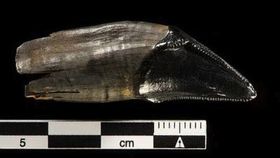


Fossils uncovered in a coal mine suggest that humans and saber-toothed cats met about 300,000 years ago in Europe.
Excavating at the Schöningen open-cast coal mine in north-central Germany, researchers from Lower Saxony Heritage Authority and of the University of Tübingen discovered the remains of a saber-toothed cat preserved in the same layer as wooden spears over 7 feet long.
The mine was once the site of a shallow lake, and the researchers suggest that early Europeans camped around the lakeside likely encountered, and defended themselves against, a young adult Homotherium latidens. These prehistoric cats are smaller than the more iconic, beefier saber-toothed tiger, Smilodon from the Late Pleistocene.
Scimitar-toothed might be a more precise description. These cats have canines that are shorter, flatter, and coarsely serrated. They’re also built for speed, rather than power like the dirk-toothed tigers you’d find at the La Brea Tar Pits in Los Angeles. But this was no housecat. Measuring over 3 feet at the shoulder and weighing well over 400 pounds, the cat had razor-sharp claws and upper-jaw canines measuring more than 4 inches long.
In that same level, the researchers also found bones and stone tools, which they believe belong to Homo heidelbergensis.

The work was published in a report by the Lower Saxony heritage authority, the Niedersächsisches Landesamt für Denkmalpflege
[Via Universitaet Tübingen]
Images: Niedersächsisches Landesamt für Denkmalpflege