Nature
 PUBLISHED


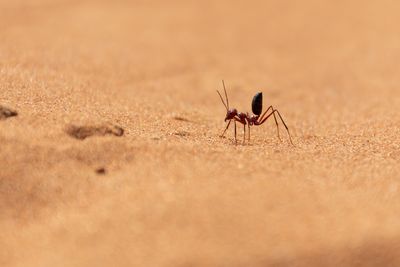


They might only be small, but desert ants have a powerful skill – they can orient themselves to the Earth’s magnetic field. Where in their brains this information is processed was previously unclear, but by disrupting magnetic fields early in the ants’ development, researchers now believe they’ve uncovered the responsible regions.
In a previous study, the research team discovered that young desert ants go on “learning walks” just outside the nest entrance, spinning around on their body axis and looking back at the nest in order to orient themselves to the Earth’s magnetic field. As study author Pauline Fleischmann put it in a statement, "Before an ant leaves its underground nest for the first time and goes in search of food, it has to calibrate its navigation system.”
To figure out which regions of the brain were involved in this process, the team set to manipulating the magnetic field when the ants were on their learning walks and then looked for changes in their nervous systems.
They did this by taking young worker ants that had not yet gone on learning walks and only allowing them to set out for the first time under particular conditions: either a permanently manipulated magnetic field, or natural conditions.
The researchers then looked at whether any structural changes had occurred in the ants’ nervous systems. This was relatively simple, as desert ants only have a small nervous system – their brain contains fewer than a million neurons, small fry compared to humans.
"Our neuroanatomical brain analyses show that ants exposed to an altered magnetic field have a smaller volume and fewer synaptic complexes in an area of the brain responsible for the integration of visual information and learning, the so-called mushroom body," explained Fleischmann and fellow author Robin Grob.
Analysis also showed structural changes in the ants’ central complex, a part of the brain that’s involved in spatial orientation. Under normal circumstances, the ants instead showed an increased number of synaptic connections – the places where neurons link up and chat with each other – in both this region and the mushroom body.

Because these particular regions are involved, the authors suggest that the processing of magnetic information is not just about successful navigation, but also plays an important role in the development of the ants’ spatial memory.
"Ants need a functioning magnetic compass during their learning walks in order to calibrate their visual compass and at the same time store images of the nest environment in their long-term memory," stated Fleischmann and Grob.
The researchers also believe that the results deliver an important glance into neuronal development and plasticity across the board, not just in desert ants. "The results provide valuable information on how multisensory stimuli can influence neuronal plasticity of brain circuits for navigation in a critical phase of brain maturation,” said author Wolfgang Rössler.
As for what’s next, the researchers want to achieve something that’s never been achieved with magnetic-field-orienting animals before: finding out which sensory organ receives the magnetic information. Hopefully this will also involve watching the ants on their learning walks (Hey Siri, play Spinning Around by Kylie Minogue).
The study is published in PNAS.