


 Nature
 PUBLISHED


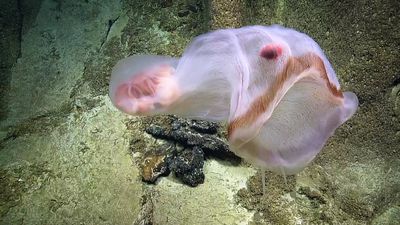


Deepstaria looks like a cross between a ghost emoji and a floating plastic bag, but don’t be tempted to underestimate this shape-shifting jellyfish: it’s among the largest and strangest invertebrate predators of the deep sea.
There are two recognized species of Deepstaria – D. enigmatica and D. reticulum – named after the US research sub Deepstar 4000 that first discovered the genus in the 1960s.
On the taxonomic family tree, they are part of a class called Scyphozoa, which are typically referred to as true jellyfish. However, Deepstaria has some significant differences from their other jelly relatives.
Jellyfish typically have spindly tentacles with a relatively small bell – yet Deepstaria is the opposite, featuring very small tentacles and a large bell that stretches like a parachute. The extensive bell of Deepstaria features a distinct geometric mesh pattern, which are the channels of its gastrovascular system that deliver nutrients around its body.
Many jellyfish live in groups known as shoals or swarms because they tend to be caught in ocean currents, but Deepstaria appear to be lone rangers that live a relatively solitary existence in the murky depths of the ocean's abyss.
The jellies live in the bathypelagic region of the world's oceans at depths ranging from 600 to 1,750 meters (1,968 to 5,741 feet). This part of the ocean is known as the midnight zone because it has little to no natural light and features cold, salty water that hovers around 4°C (39°F).
In 2018, scientists made a rare live observation of a D. enigmatica near Mexico's Pacific coast and reported that it measured 68.3 by 55.7 centimeters (~27 by 22 inches). Although this was believed to be a relatively large individual, Deepstaria jellyfish are large for deepsea invertebrate predators.
One of the most remarkable observations came in 2019 when scientists onboard the EV Nautilus research vessel captured video footage (above) of a Deepstaria jellyfish in the Pacific Remote Islands National Marine Monument.
Amid many “woahs” and “oooooohs”, the researchers noted that a resident red isopod was living inside the blanket-like bell. It’s uncertain whether this relationship is symbiotic (as in, both parties are benefiting from the alliance) or parasitic (a one-sided friendship that only benefits the isopod).
The isopod remains protected from predators inside the jellyfish bell, plus it likely obtains nutrients from its body, but it is unclear what benefit the jellyfish is gaining. Nevertheless, small crustaceans and other creatures are often found living inside the bell of Deepstaria, suggesting this unlikely bond runs deep.




 1
1