Nature
 PUBLISHED


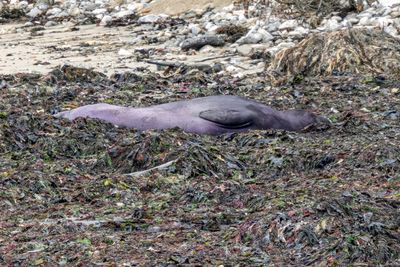


If you go down to Año Nuevo State Park in California, you might be able to see the elephant seals resting on the beach. If you look closely, however, you might notice one of them has turned from beautiful slate gray into something a little more eggplant colored.
At Año Nuevo State Park, over 10,000 northern elephant seals return each year to breed, molt, and give birth on the coast. Visitors can spot them from viewing areas between April and November.
This particular lilac-hued seal was spotted and photographed by one of the park's docents, Irene Reti, on June 23, 2026.
It has since been causing a stir on social media, with many speculating what could be causing the seal's change in hue. While some suggest that it could be a genetic quirk, the likes of which can turn animals into black or white versions – and more color quirks – and even cause unusual markings, others suggest it could be down to diet.
In sea otter populations, the very bones of the otter can turn purple after consuming a large amount of purple sea urchins, which deposit a chemical into the bloodstream, eventually seeping into the bones and turning them purple. However, this does not affect their fur and, therefore, is probably not the explanation for the seal.
Instead, “The late spring and early summer is when most elephant seals molt. It is also when there is an abundance of algae that washes up on the beaches. This algae can temporarily dye the fur of the seals!" director of the Año Nuevo State Park for UCSC, Dr Patrick Robinson, explained in a statement sent to IFLScience.
"When they lay on the algae for long periods, this color can be more extreme. Various species of red algae discolor the fur and are particularly striking!”
.jpg "A group of northern elephant seals lie on the beach, the furthest one from the camera is purple not grey like the others.")
Different colored animals crop up surprisingly often, and while sometimes it's due to a natural quirk in genetics, sometimes it's caused by accidents, sometimes by human interference (please don't do this), and sometimes, like this snowy owl, it genuinely remains a mystery.
One of the most well-known reasons for an animal changing color is the red algae that turns flamingoes their striking color pink.
"In the wild, they are eating lots of little [brine] shrimp and microscopic algae, and all of those things contain a pigment [carotenoids] inside them. When the flamingos eat them, that gets transferred into the flamingos and [then] into their feathers," Amanda Ferguson, Diet Management Officer for both Whipsnade and ZSL London Zoo, told IFLScience in Issue 45 (April 2026) of CURIOUS.
"Carotenoids are a special group of substances. The colors that they generally give are kind of the red, yellow, orange kind of color, and that's the color that these natural organisms have inside them that then gets transferred into the flamingos, into their feathers, so they grow out with these beautiful red colored feathers."
If you're curious whether feeding an animal like a flamingo a food that had a color injected into it would change their color, it's a no.
"If you give any other dye or substance that's not a carotenoid, it will get broken down in the stomach and digested and metabolized," Ferguson told IFLScience.
"It doesn't ever get transferred into the feathers. If you feed it lots of green food coloring or blue food coloring, it won't make any difference to the bird at all, it will just get digested and [eventually] excreted."
Back in Año Nuevo State Park, the elephant seal viewing areas are reopened after a roughly six-week period of closure in April due to an outbreak of avian flu. According to NBC Bay Area local news, this represented the first instance of HPAI H5N1 being detected in elephant seals on the West Coast. This outbreak killed around 30 seals, most of them pups.
For those not able to visit the elephant seal population, you can always watch them via the livestream.