Nature
 PUBLISHED


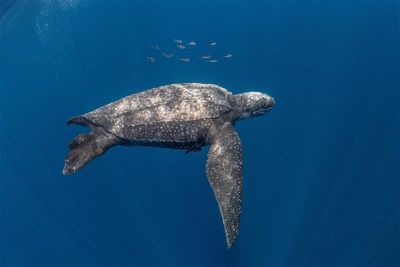


A new potential world record has been set and achieved by an enormous, finned critter. Back in March this year, a Western Pacific Leatherback turtle left its nesting sites in the Solomon Islands and then dove 4,409 feet (1,344 meters) below the waves.
This achievement beat the previous record holder by 210 feet (64 meters), which was set by another leatherback turtle in 2006, according to the Guinness World Record. This, LiveScience has shown, is deeper than submarines are recorded as going (they tend to go down to depths of 2,950 feet (900 meters). In contrast, human divers have only gone down as far as 1,090 (332 meters).
Leatherback turtles have long been known to be the deepest-diving reptiles in the world. Their ability to disappear into the ocean’s depths puts them among the ranks of diving mammals, such as the earless seals and whales.
Unlike other species of sea turtle, leatherbacks do not graze in shallow waters. In fact, they barely ever come close to land unless it is to nest. It is only the females who return to land, which means scientists known very little about the lives or males or even juvenile specimens.
From the moment they reach the water for the first time, these large reptiles head out into the open ocean where they feed on jellyfish that move around at various depths.
When they dive, these turtles can hold their breath for around 90 minutes each time. Their shells (known as a carapace) are specially adapted to contract and expand with changes in pressure as the animals dive and then resurface again.
The turtle that recently broke the world record was being tracked as part of an ongoing satellite tracking study that is trying to protect leatherback turtles.
According to researchers, the turtle, known as “Uke Sasakolo” laid her eggs at the Sasakolo nesting beach in the Solomon Islands in the South Pacific. She then set off back to the open ocean where she and most of the other nesting turtles headed south into southern Australian and New Zealand waters. It was soon into this migration that Uke Sasakolo, which means “From Sasakolo”, undertook her record-breaking dive.
The Solomon Island’s nesting leatherback turtles may be incredible divers, but they are also critically endangered. At the moment it is estimated that there are only 1,400 breeding adults on the planet.
Their numbers are so low that conservationists are desperate to track all the breeding adults they can find, so they can help protect their nests. Females like Uke Sasakolo are often tagged, which allows researchers to track their movements and, in this instance, bath in awe that their amazing ability to dive.