Space and Physics
 PUBLISHED
 15
15



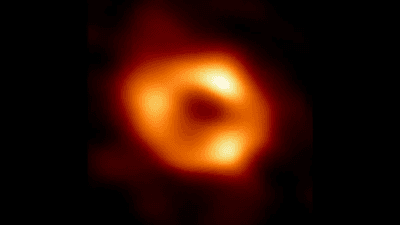


Newly published research suggests that the first-ever image of Sagittarius A*, the supermassive black hole at the center of the Milky Way, is not an accurate representation of the cosmic object. The image was revealed in 2022 by the Event Horizon Telescope (EHT) collaboration that took the first-ever image of a black hole back in 2017, and it has been validated by many researchers since.
As you can see in the EHT image above, the supermassive black hole appears like a glowing doughnut. What we are seeing is the shadow of the black hole at the center, surrounded by a bright ring structure created by the matter that falls into the black hole. We can't see the black hole itself as nothing, including light, can escape a black hole.
However, the new study claims that the structure should not be a nice neat ring at all. Instead, their analysis suggests that Sagittarius A* – which has a mass equivalent to over 4 million Suns – has an elongated accretion disk, the region where material falls into the black hole, which is not shown in the image. They argue that part of the ring shape is nothing but an artifact created by the analysis.
“Our image is slightly elongated in the east-west direction, and the eastern half is brighter than the western half. We think this appearance means the accretion disk surrounding the black hole is rotating at about 60 percent of the speed of light,” lead author Assistant Professor Miyoshi Makoto of the National Astronomical Observatory of Japan said in a statement.
“Why, then, did the ring-like image emerge?" he posed. "Well, no telescope can capture an astronomical image perfectly. We hypothesise that the ring image resulted from errors during EHT's imaging analysis and that part of it was an artefact, rather than the actual astronomical structure."
To create the Event Horizon Telescope image in the first place, the team combined multiple different radio telescopes from all around the planet observing the region at the same time. This basically created a radio telescope as big as Earth, allowing it to deliver a much higher resolution image than would have been possible with a single instrument.
The task was extremely difficult, not a matter of just taking a snapshot. The environment around Sagittarius A* is very dynamic and the software used to analyze the EHT data had to be created for the task. In this new study, the team reanalyzed the EHT data with more commonly available analysis methods and found a different answer.
Both scenarios are plausible. The authors of the second study believe that new observations like the one conducted by the EHT over the last several years might provide a clearer picture of the true shape of Sagittarius A*, so we'll have to wait and see.
The study is published in the Monthly Notices of the Royal Astronomical Society.