Space and Physics
 PUBLISHED



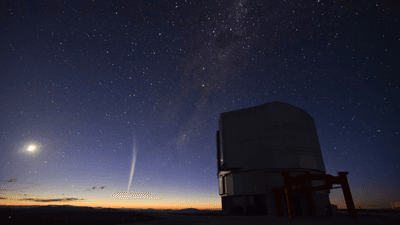


This Saturday, the comet C/2026 A1 (MAPS) will pass within around 160,000 kilometers of the surface of the Sun. There’s a high chance it will break up and vaporize under the staggering heat, but if it doesn’t, there could be quite a display as it speeds away from its nemesis.
Comets usually fail to live up to their hype. Uncertainties about their size and composition mean there’s a range of predictions about what each will look like from Earth, and it’s all too easy to focus on the most optimistic scenarios. Everyone wants a great spectacle like comets Hale-Bopp and McNaught gave the northern and southern hemisphere respectively in 1996 and 2007.
This is most true of sungrazer comets, particularly members of the Kreutz group, which have paths that take them from the distant outskirts of the Solar System right through the solar corona. They’ve granted us some of the brightest comet encounters of the past two centuries, but many more have been annihilated by the experience, barely visible other than to those with advanced equipment.
Not only is C/2026 A1 (MAPS) a Kreutz sungrazer, but it will pass even closer to the Sun than the most famous members of its group.
At time of writing C/2026 A1 (MAPS) is about magnitude 7, making it invisible to the naked eye even against dark skies. Since it’s only 16 degrees away from the Sun from our perspective and closing fast, dark skies are a fantasy – it’ll only be above the horizon during daylight and twilight.
The comet is brightening exceptionally fast, however, and it is currently predicted to have a peak magnitude of -2.7 – similar to Jupiter – on Saturday. That would be an increase of about 10,000 times compared with Monday. Unfortunately, it will also be just 2.6 degrees away from the Sun, so looking for it without protection is a sure path to going blind.
After that is when things get uncertain. At the time, the comet will be 860,000 kilometers (515,000 miles) from the center of the Sun, which places it 160,000 kilometers (100,000 miles) above the area considered the Sun’s surface, defined as the point below which the Sun is opaque to visible light. That’s less than half the distance from Earth to the Moon.
The Sun’s intensity there would melt many metals, let alone the mix of ices comets are primarily made of, so even though it will spend only a short time in the Sun’s proximity, it is likely the comet will break into several pieces. If so, this will expose more of its material to sunlight, causing it to rapidly vaporize.
However, some Kreutz group comets have been made of sterner, or probably larger, stuff, and have survived close passages, putting on magnificent displays on the outward journey, in some cases becoming brighter than the full Moon. If this happens, its position will make for more favorable viewing from the southern hemisphere, but it should also be possible to see from the north. Only time will tell.
C/2026 A1 (MAPS) set the record for being the most distant Kreutz group comet from the Sun at the time it was detected, which also meant we had a record-breaking 11.5 weeks between its discovery and its closest approach.
The early discovery in part reflects improvements in telescope capacity, but also indicates A1 (MAPS) is at least larger-than-average, so a bright display isn’t out of the question, particularly if it breaks up shortly after its closest approach. This would allow sunlight to reach parts of the comet that were hidden internally on the way in, leading to large amounts of dust escaping soon afterwards.
Even if C/2026 A1 (MAPS) joins the ranks of doomed comets most of us never get to see directly, solar observatories will feast on the view.
A better prospect for amateur observers is probably C/2025 R3 (PanSTARRS), which will never get as bright as C/2026 A1 (MAPS), but will be 20 degrees from the Sun on April 19. At that point, it is expected to be magnitude 3 – easily visible under dark skies, and forward scatter could make it brighter still.