Space and Physics
 PUBLISHED


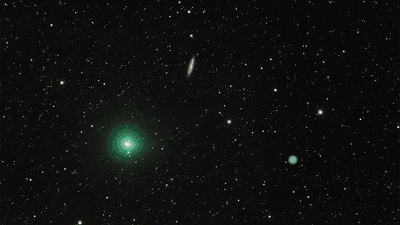


The often controversial Harvard astronomer Avi Loeb, fresh from speculating whether interstellar comet 3I/ATLAS could be an alien spacecraft, is back pointing at another unusual comet and asking whether it could contain alien technology.
Comet 41P/Tuttle-Giacobini-Kresak, as you might be able to guess from the name, has been discovered no less than three times in the last few centuries. Horace Parnell Tuttle, an American Civil War veteran and astronomer working at the Harvard College Observatory, was the first to spot the comet on May 3, 1858. Next came Michael Giacobini, who discovered the comet in 1907. On its third discovery, by Ľubor Kresák in 1951, astronomers finally had enough information about the comet to predict its orbit, and link the several sightings to the same astronomical body.
41P/Tuttle-Giacobini-Kresak is now known to be in the Jupiter family of comets, going from a little inside Jupiter's orbit to almost as far as Earth on its 5.4-year orbit. It is notable for its large outbursts and highly variable brightness. In 1973, the comet was particularly bright following one outburst, reaching magnitude 4.
In May 2017, the comet got a little weirder. Observations by NASA’s Swift spacecraft showed that its rotation had quite abruptly slowed, and was spinning three times slower than it had been when it was observed by the Discovery Channel Telescope at Lowell Observatory in Arizona.
In a study published in late March, astronomers tracking the movements of Comet 41P/Tuttle-Giacobini-Kresak found that it appears to have slowed its rotation, before the direction of its rotation reversed.
"The previous record for a comet spindown went to 103P/Hartley 2, which slowed its rotation from 17 to 19 hours over 90 days," Dennis Bodewits, at the time an associate research scientist at the University of Maryland, said in a 2018 NASA statement. "By contrast, 41P spun down by more than 10 times as much in just 60 days, so both the extent and the rate of this change is something we’ve never seen before."
Over that time, the comet went from rotating once every 20 hours to once every 53 hours. In the March 2026 paper, David Jewitt, an astronomer in the Department of Earth, Planetary and Space Sciences at UCLA, used archived data from the Hubble Space Telescope to study what happened to the comet following these observations.
Hubble observed the comet from December 11-14, as part of the telescope's General Observer program. Finding 24 useful observations of the comet, Jewitt determined that the rotation of its nucleus continued to change after its closest approach to the Sun, likely leading to a reversal of its spin.
"The simplest explanation of the changing period is that the nucleus was torqued by recoil forces from anisotropic outgassing, as has been widely demonstrated in other comets," Jewitt explains in his paper, which ha. "Indeed, ground based observations set an upper limit to the nucleus radius rn ≲ 0.7 km, a size which renders the nucleus susceptible to rapid spin evolution through outgassing torques."
While outgassing is to be expected in a comet, the outgassing seen here is particularly jet-like. What is particularly puzzling about the comet is that it has been determined to be in a stable orbit.
"The lifetime of the nucleus to rotational instability (a few decades) is short compared to the dynamical lifetime (∼103 [years]) in its current orbit," Jewitt adds. "The continued existence of 41P therefore suggests that either the current level of outgassing activity is substantially larger than on average, and/or that the nucleus is a remnant of a once much larger body."
Further observations could tell us more about cometary rotation, and perhaps how comets are destroyed by their own spin.
“The evidence is that comets just don’t live that long,” Jewitt told Jonathan O’Callaghan, writing for The New York Times. “There’s some other process that destroys the comets, and I think it’s rotation.”
Alternatively, Jewitt suggests that Hubble could have observed the comet during a particularly active period, resulting in overestimates of mass loss and the twisting motion produced by outgassing, as well as underestimating the lifetime of the comet.
"But there is a third possible interpretation. Perhaps 41P/Tuttle-Giacobini-Kresák is a Trojan Horse with the outside appearance of a natural iceberg but with technology embedded in its belly," Loeb writes on his blog.
"In that case, its spin reversal is a technological signature. Based on my personal experience – if Jewitt have discussed this technological possibility, his paper would have been blocked from publication. Indeed, this possibility is not mentioned in the published paper, but I am free to mention it here in the absence of gatekeepers – within the safe space of my essay."
While we get the appeal of suggesting aliens – who would not like to have an answer on whether we are alone in the universe? – this suggestion is unnecessary given what we have observed of the comet so far. Loeb has suggested that other objects may be alien technology in the past – including suggesting 1I/'Oumuamua could be an alien lightsail, 3I/ATLAS could be an alien spacecraft, and asteroid CNEOS 2014-01-08, which crashed to Earth in 2014, could have been sent here by aliens.
None of these hypotheses have shown much signs of promise, with natural explanations favored by almost all astronomers. Searches for technological signatures on 3I/ATLAS and 1I/'Oumuamua have both come up with nothing, and both objects (whilst interesting, and different to Solar System objects) have shown little signs of doing anything out of the ordinary, let alone using Jupiter in braking maneuver, a possibility suggested by Loeb that failed to emerge.
As for 41P/Tuttle-Giacobini-Kresak, the comet will dip back into the inner Solar System in 2028, giving us further opportunities to observe this cosmic oddity, and pin down what is going on with it. We wouldn't hold our breaths for signs of aliens, given we have observed a grand total of zero (0) alien artifacts so far.