Space and Physics
 PUBLISHED




Stars have magnetic fields that initially get stronger as the speed of the star’s rotation increases. There are still aspects of this astronomers don’t understand, but the mystery turns out to be much greater when the stars orbit each other every few days or less. The implications of this are not entirely clear, but the discovery demonstrates how when two even well-understood phenomena interact the outcomes can be hard to predict.
Magnetism is constantly throwing curveballs into apparently simple astronomical phenomena, making the universe a much more interesting, but hard to grasp, place. Just as the Earth and some other planets have their own magnetic fields, stars can too.
These fields can reach astonishing strength in magnetars – highly magnetic neutron stars – but they exist in main sequence stars like the Sun. It’s the Sun’s magnetic field getting tangled that produces sunspots and solar flares, which make this topic something we need to understand, rather than just want to.
The strength of a star’s magnetic field can be measured from enhancement of certain spectral lines, so astronomers have a very large database to work from. A while ago they noticed that for most stars the strength of the field increases the faster the star rotates, but that this breaks down for stars that rotate once every 3-10 days or so. These stars, astronomers have observed, “saturate” their magnetic fields, with fields not getting stronger even if they spin faster.
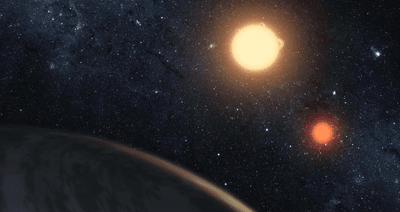
However, a new study reveals, this rule only applies to solo stars like the Sun, or stars in binary (or larger) systems with orbits wide enough to take more than 30 days. Those two categories between them account for the bulk of stars. There are more stars in binary systems than solo, but most multi-star systems are quite wide-set. A glance at our nearest neighbors paints a picture. Alpha Centauri A and B orbit each other every 80 years, so for magnetic purposes they behave like solitary stars. Proxima Centauri, technically part of the system, takes more than half a million years to orbit.
Yet for the small proportion of stars in tight orbits the authors found magnetism can keep increasing even when their rotation times are between 0.5 and 1 day. Somehow the stars are whipping up each other’s magnetic fields, sometimes leading to remarkably powerful outcomes. Counterintuitively, the effect seems to be stronger for almost circular orbits than more eccentric ones.
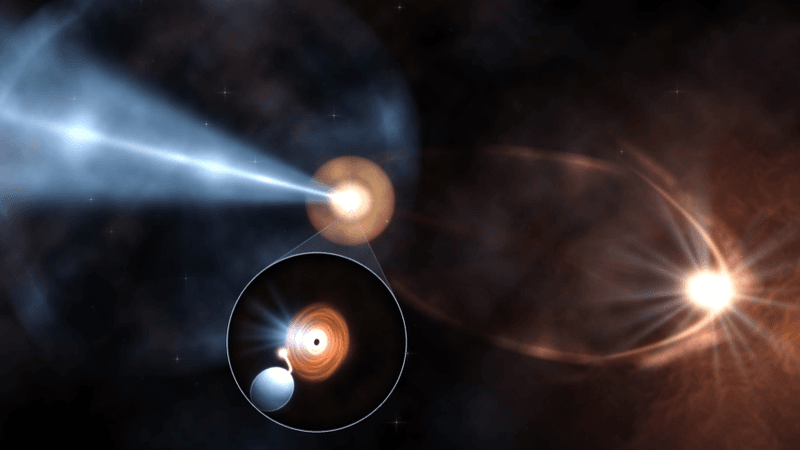
At this point no one knows the consequences of such strong fields in main sequence stars. How, for example, might so-called Tatooine planets be affected? Recently astronomers have discovered phenomena they initially couldn’t explain were being produced by red and white dwarfs in orbits lasting a few hours. How such systems are producing these long-period radio signals is still unknown, but polarization of the signals points to a powerful magnetic component. Understanding the effects of tight magnetism on paired main sequence stars might offer clues.
Meanwhile, the authors of the paper describing this work have found something even more mysterious. When stars in tight orbits rotated in less than half a day “supersaturation” occurs. Saturated magnetic fields don’t get any stronger the faster a star rotates, but supersaturated ones actually get weaker for rotation periods shorter than 0.5 days (i.e. about 50 times faster than the Sun). So far, the authors are not even game to take a guess at why.
Stellar magnetic fields – how do they work?
The study is published in Nature Astronomy.