Nature
 PUBLISHED
 1
1


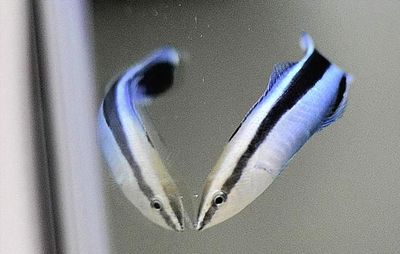


Cleaner wrasse quickly learn to recognize themselves in mirrors, and take advantage of the information their reflection provides. They also experiment with the mirror in a way we might call playful, and they seem to learn very fast for creatures we are used to looking down on.
The oceans are alive with parasites that drain the blood and energy of fish. Several unrelated species have occupied the niche this creates, earning the name "cleaners". The cleaner gets to eat the parasite, while the client is relieved of something painful and potentially lethal. Although it’s a win-win, it also requires sophisticated negotiations, as the cleaners are often just the size of fish the client would normally eat, and need assurance they won’t become their clients’ dinner.
Several species of cleaner wrasse are the most studied of ocean cleaners, famous for the “cleaner stations” they establish on coral reefs where families ply their trade to larger fish that queue for parasite relief. Bluestreak cleaner wrasse (Labroides dimidiatus) advertise their services through their electric color scheme. Shumpei Sogawa of Osaka Metropolitan University leads a team exploring wrasse intelligence.
Sogawa and colleagues inserted coloring that looks like the parasites into wrasses’ throats in an adaptation of the mark test used to demonstrate self-recognition in great apes – subsequently also found in some, but not all, other mammals.
Normally, a family member might quickly remove the pseudo-parasite, but the wrasse were left alone, other than a mirror placed in their tank. Even fish that had never previously seen their reflection quickly – sometimes in half an hour – recognized themselves and attempted to get rid of the mark.
“In earlier cleaner wrasse mirror studies, the procedure was typically the fish see a mirror for several days, they habituate to it and stop reacting socially, and a mark is added,” Sogawa said in a statement. “In this study, the order was reversed, the fish were marked first, then the mirror was introduced for the first time. The fish were likely aware of something unusual on their body, but they couldn’t see it. When the mirror appeared, it immediately provided visual information that matched an existing bodily expectation, hence scraping occurred much faster.”
Few of the previous studies on mirror self-recognition in animals explored the timing subjects take to catch on. It has been widely assumed that it’s a slow process, particularly for creatures as distantly related to us as fish.
Putting the mirror to use so quickly is impressive enough, given all the species that cannot recognize themselves and treat their reflection as a rival, but the cleaner wrasse also did something that surprised the researchers. Some fish would pick a piece of shrimp up from the bottom of the tank and let it go at a height great enough to watch it fall, both directly and in the mirror. They would trace the line its reflection made as it fell by touching their mirror with their mouths.
Sogawa and colleagues interpret this as wrasse with the makings of scientists experimenting on the illusion the mirror creates with the shrimp as a tool. Manta rays and dolphins do something similar, tracking the rise of bubbles’ reflections. The discovery some wrasse use tools is quite new – discovering they use them as toys or lab equipment is a step beyond.
“These findings in cleaner wrasse suggest that self-awareness may not have evolved only in the limited number of species that passed the mirror test but may be more widely prevalent across a broader range of taxonomic groups, including fish,” Sogawa said. “It is highly likely that mirror self-recognition will be observed in many species where mirror tool use has been reported.”
The researchers previously published even more impressive evidence of self-recognition in L. dimidiatus. After teaching them to recognize themselves in the mirror, Sogawa and colleagues showed the wrasse photographs of themselves. Despite not being able to use movement to trigger recognition, the wrasse were much less likely to attack their own photos than those of other members of their species. Even when their own face had been combined in a photograph with the body of a different fish, the wrasse generally knew not to attack.
The findings not only demonstrate that mirror self-recognition may occur in more species than has been suspected, but that it can develop surprisingly quickly, rather than animals needing 3-5 days of exposure, as many studies have provided. Then again, since cleaner wrasse have been found to make other fish smarter, it's not so surprising they're pretty clever themselves.
The study is open access in Scientific Reports.