Nature
 PUBLISHED
 49
49





China is hellbent on a mission to plant billions of trees, but a new study suggests these artificially planted forests are behaving quite differently from their natural counterparts.
China's big reforestation push
Since the 1970s, China has planted more than 66 billion trees (according to some estimates) in one of the largest reforestation projects ever undertaken.
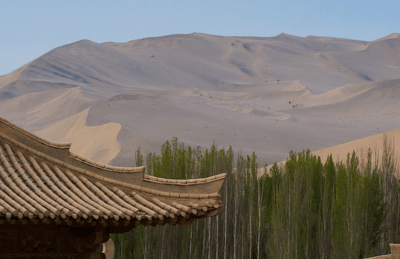
Many of these trees are part of a “Great Green Wall” that acts as a natural barrier against the northern desert’s sandstorms, some of which are so gusty they reach Beijing, while sequestering carbon from the atmosphere and halting aridification.
Along with this northern frontier, a huge amount of rejuvenated woodland exists in the belly of southern China, known for its humid subtropical and tropical monsoon climate, ideal conditions for plant life to boom.
By 2020, these newly planted forests covered 90.31 million hectares, accounting for a staggering 36.6 percent of the nation's total forest land.
What's different about the new forests?
While the sheer scale of this greening effort has been carefully tracked for decades, a new analysis by Peking University reveals that these newly engineered forests don’t function the same way natural ones do. The discovery suggests that the global climate models we use to understand forest behavior might be fundamentally mistuned.
Using satellite data and machine learning, researchers compared how planted and natural forests react under identical environmental conditions. They found that China's planted forests increased their leaf cover two to three times faster than natural forests. Part of this hypergrowth has to do with the trees' sprightly age, as younger leaves are naturally more efficient and receptive to taking in CO2.
However, youth isn't the only factor. Even when the researchers strictly accounted for tree age and local growing conditions, the planted forests still grew 4.6 percent faster than expected. This growth spurt was even more pronounced in mixed and evergreen forests, which showed remarkably intense responses to rising atmospheric CO2.
According to the study, this divergence highlights a critical blind spot in current forecasting. Many ecosystem models treat all forests with a broad brush, ignoring how and when the forests came to be.
“These findings underscore the importance of forest age and management history—dimensions currently overlooked in major ecosystem models, leading to systematic underestimation of LAI [leaf area index] increase in young forest regions,” the study authors concluded.
Is reforestation making a difference?
None of this is to say that China’s immense reforestation project is in any way "bad." Rather, it means these human-made ecosystems are performing in ways that previous models didn't expect.
Earlier this year, research found the immensity of trees planted around the Taklamakan Desert absorbed about 8.3 million tons of CO2 per year while only releasing about 6.7 million tons between 2004 and 2017. This effectively meant the forest had turned into a carbon sink, “sucking up” more greenhouse gas from the atmosphere than it emitted.
From greener spaces and wildlife habitats to stabilized soil systems, planting trees has a myriad of benefits beyond sequestering carbon from the atmosphere, but it is not a silver bullet to tackle climate change.
Then again, as China is showing, it’s certainly not a bad place to start.
The new study is published in the journal Geophysical Research Letters.