Humans
 PUBLISHED


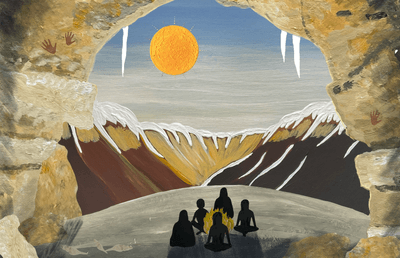


The last Ice Age made mountain conditions hostile, and our ancestors mostly retreated to the lowlands if they’d been living higher up before. Even in Australia’s famously hot climate, it was thought the continents’ mountains were off limits to Indigenous people, with no record of a presence through the cold millennia. Excavation of Dargan Shelter has changed that, with hundreds of stone tools, many from before the gentle Holocene began.
Even more remarkably, many of the finds date from the Last Glacial Maximum, the time 23,000-19,000 years ago when the world cooled even below preceding Ice Age conditions.
The Dargan Shelter sits at an elevation of 1,073 meters (3,520 Feet) in the Blue Mountains west of Sydney. Today, the area is known for its scenic beauty and forests. However, Dr Amy Mosig Way told IFLScience that during the Ice Age, conditions were 8°C (14°F) colder than today. The tree line stopped 400 meters below the shelter, so not only was it bitterly cold even in summer, but there was no local wood to make a fire. It would have been icebound in winter and surrounded by grassy tundra in summer.
[People must have] either gone for niche reasons like medicinal plants, or have been going there for ceremonies.
Dr Amy Mosig Way
Yet when Way and colleagues excavated a 3-square-meter (30-square-foot) area of the cave, they found items dating back 20,000 years. This included 693 stone artifacts, as well as some rock art of unknown age.

The excavation was begun by Wayne Brennan, an archaeology mentor at the University of Sydney and knowledge holder of the Gomeroi people, whose lands border the shelter. In recent times, the shelter was a meeting place for the Dharug, Wiradjuri, Dharawal, Wonnarua, and Ngunnawal peoples, as well as the Gomeroi, and it seems it may have performed a similar function in colder times.
Items in the cave come from the Hunter Valley and Jenolan, hundreds of kilometers away in different directions. “They were either traded or brought there directly,” Way told IFLScience. “The Sydney Basin was a great place to live at the time, with food and water all year round.” To climb a mountain, particularly one in a broad range like the Blue Mountains, people must have "Either gone for niche reasons like medicinal plants, or have been going there for ceremonies,” Way said.
Similar things occurred on other continents at the time. “There was no population pressure in the world then, you could just as easily have lived in the lowlands. People chose to go up into these high terrains,” Way continued. “It’s really a global story about human adaptability and curiosity and going into every niche, so that is where social explanations are best.”
The absence of signs of human presence from before 20,000 years ago – a part of the Ice Age when conditions were slightly less forbidding – is puzzling. However, Way told IFLScience this is probably a sampling issue. “If we’d dug 2 meters north, we might have found something,” she said. Alternatively, nearby caves might have been used instead.
“Our people have walked, lived and thrived in the Blue Mountains for thousands of years, and we knew the cave was there. It is not only a tangible connection to our ancestors who used it as a meeting place for sharing, storytelling, and survival, but is a part of our cultural identity. We need to respect and protect our heritage for the benefit of all Australians,” said co-author Leanne Watson Redpath of the Dharug people in a statement.
The study is open access in Nature Human Behavior.