Nature
 PUBLISHED


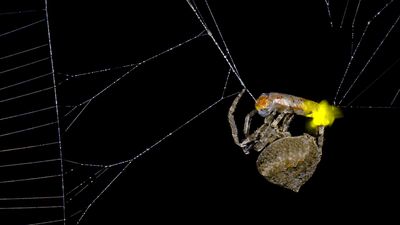


The light signals of fireflies appear to have been highjacked by orb-weaving spiders. Scientists believe they have observed the spiders manipulating captive flies so that they flash like females, luring more male fireflies into their trap. Can’t trust anything anymore.
The spider is Araneus ventricosus, which is partial to feeding on the firefly species Abscondita terminalis. The males of these fireflies attract females by making multi-pulse flashes with two lanterns, while the females just pulse a single lantern to attract males.
Now, new research has captured evidence that points to A. ventricosus being able to hijack the fireflies’ messaging system by making males trapped in their web flash like females. This then lures in more fireflies who think they are approaching a female, when in fact, they’re flying right into a trap.
First author of the new study, Xinhua Fu, from Huazhong Agricultural University, China, first noticed there was a strange skew in the webs of the orb-weaving spiders. Each web seemed to have only male fireflies trapped in them, which got the team thinking there may be some mechanism to explain why only males were getting sucked in.

“Drawing from extensive field observations, we propose that A. ventricosus practices deceptive interspecific communication by first ensnaring firefly males in its web and then predisposing the entrapped male fireflies to broadcast bioluminescent signals that deviate from female-attracting signals typically made by A. terminalis males and instead mimic the male-attracting signals typically made by females,” the researchers wrote in their paper. “The outcome is that the entrapped male fireflies broadcast false signals that lure more male fireflies into the web.”
Field experiments revealed that the spider’s web was more likely to capture a male firefly if the spider was present at the time, and that the signals males were making when the spider was there looked more like those of a female than a male. It seems the spiders are strong-arming the fireflies into sending out the wrong message.
“While the eyes of orb-web spiders typically support limited spatial acuity, they rely more on temporal acuity rather than spatial acuity for discriminating flash signals,” said study co-author and behavioral ecologist Daiqin Li from Hubei University in a statement. “Upon detecting the bioluminescent signals of ensnared male fireflies, the spider deploys a specialized prey-handling procedure involving repeated wrap-bite attacks.”
Whether it’s the spider’s venom that manipulates the fireflies’ flashes, or the bite itself, remains to be established, but it’s a curious new example of indirect signaling by a predator. The study authors suggest that many more examples may exist out in nature, capitalizing on the signals, sounds, and pheromones produced by prey species so that predators can use them to their advantage.
Guess nothing drives innovation quite like an empty stomach.
The study is published in the journal Current Biology.