Space and Physics
 PUBLISHED


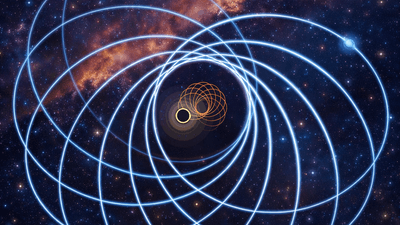


The four gravitational wave observatories around the world have been busy lately, revealing hundreds of detections. These provide statistical insights into the collisions between the incredibly compact objects that cause them, whether neutron stars or black holes. The new detections have also allowed us to find some extreme space oddities, including a black hole–neutron star merger that collided from an oval rather than a circular orbit, something never seen before that challenges assumptions about the origins of "mixed mergers".
If you know a little about space, this might not seem odd at all. Father of modern astronomy, Johannes Kepler, worked out that the orbits of planets around the Sun are ellipses, so oval, in the early 1600s. Sure, some might be very close to a circle, like Earth’s, but ovals are a common orbit in space. It turns out, not for neutron stars orbiting black holes.
In all previous collisions reported, neutron stars were in a circular shrinking orbit around the black hole. However, the merger dubbed GW200105, which took place around 910 million light-years away, looked very different. The collision formed a black hole with a mass 13 times that of the Sun. Statistical analysis ruled out a circular orbit with 99.5 percent confidence.
"This discovery gives us vital new clues about how these extreme objects come together. It tells us that our theoretical models are incomplete and raises fresh questions about where in the universe such systems are born," co-author Dr Patricia Schmidt, from the University of Birmingham, said in a statement.
The signal detected by gravitational wave observatories is only the final instants of the collision. Still, imprinted on that space-time vibration, there is a lot of data to be gathered. New models can provide insights into the system's condition long before the merger. The presence of two such objects in an oval orbit tells us something even more original.
"The orbit gives the game away. Its elliptical shape just before merger shows this system did not evolve quietly in isolation but was almost certainly shaped by gravitational interactions with other stars, or perhaps a third companion," added Geraint Pratten, a Royal Society University Research Fellow from the University of Birmingham.
Lead author Gonzalo Morras, from the Universidad Autónoma de Madrid and the Max Planck Institute for Gravitational Physics, explained further: "This is convincing proof that not all neutron star–black hole pairs share the same origin. The eccentric orbit suggests a birthplace in an environment where many stars interact gravitationally."
The study is accepted for publication in The Astrophysical Journal Letters and is available on the ArXiv.