Health and Medicine
 PUBLISHED




What you'll discover in this article
- A science-backed brain training regimen can improve levels of Alzheimer's protein amyloid beta - the first lifestyle intervention ever shown to do so.
- "The science of it spun from about 30 to 50 years' worth of neuroscience research," research scientist Mouna Attarha told IFLScience.
- Christopher Engeland at Penn State University said it has the potential to be "something that is along the lines of personalized preventative medicine."
- Try out one of the exercises for yourself below!
We all know the importance of training our bodies to maintain our fitness, but have you thought about training your brain?
You could go on your phone’s app store right now and download any number of games that purport to do just that – I typed “brain training” into Google Play Store just now and got dozens of results. The big question, of course, is whether they actually work.
The technology we’re talking about today – BrainHQ – is different. It was developed off the back of decades of neuroscience research and scientific studies that tested how it works and how best to use it.
This is brain training, but not as you know it.
“The science of it spun from about 30 to 50 years' worth of neuroscience research from UCSF under Dr Michael Merzenich,” Dr Mouna Attarha, senior research scientist at Posit Science, the company behind BrainHQ, told IFLScience.
Merzenich’s work had shown that some types of training programs have beneficial effects on animal brains, including those of rats, cats, and primates. According to fundamental principles of neuroscience, the team reasoned, the same should apply to the human brain.
Adaptive, challenging, targeted: what makes BrainHQ different?
From the user’s perspective, it’s hard to see much of a difference between the exercises on BrainHQ and other mobile games you’ve played before. Instructions pop up on the screen, and there are six categories of exercise testing things like attention, navigation, and memory.
For example, one of the memory tests, called “Hear, Hear,” asks you to memorize and pick out a specific sound from a set of similar sounds.
Here's an exercise for you to try for yourself.
But there are several aspects, Attarha explained, that really set BrainHQ apart from other commercially available brain training software.
Firstly, it adapts to you, giving each user a personalized experience that meets them where they’re at.
Secondly, it keeps the difficulty level just right. “Brains change under moderate challenge,” said Attarha. “They don't change when things are too easy. They also don’t change when things are impossible.”
Thirdly, it focuses on skills other programs can’t train as effectively.
“There are going to be a lot of programs that focus on memory and executive functioning,” Attarha said, but BrainHQ is instead very good at targeting the speed and accuracy of information processing.
Fourthly, you get immediate feedback for the exercises, so you know instantly if you got the answers right or wrong.
And finally, the level of challenge ramps up as the exercises progress. This, Attarha told us, “is what we think is driving the positive benefits that we see here.”
“We took these basic neuroscience principles from the lab, we brought it into this human program, we tested it in clinical trials. It has these types of principles that we feel are the core ingredients to drive positive change.”
The team has the scientific receipts to prove it. BrainHQ has featured in hundreds of published papers, across diverse topics like aging, long COVID, brain injury, and – the subject of the most recent findings – dementia.
"You're in dire straits at that point"
Dementia is one of the foremost issues in global health today. A forecast in early 2025 projected that 1 million US adults could develop dementia each year by 2060. Many people are concerned about their long-term brain health and looking for ways to protect it as much as possible.
You get your blood pressure checked, you get your heart rate, you do your oxygen. And what's missing from those annual appointments is brain health monitoring.
Dr Mouna Attarha
BrainHQ not only has the potential to help with that, but it could also be a valuable screening tool.
“If you look at individuals as they get older, with age they undergo cognitive decline, and maybe they enter into a stage of mild cognitive impairment or early dementia – Alzheimer's being the most common form," Dr Christopher Engeland at Penn State University, who has run trials of BrainHQ, told IFLScience.
"Some of the earliest changes that we see in individuals cognitively are changes in processing speed. [BrainHQ] may both be particularly sensitive to detecting cognitive change with age and dementia risk early on.”
This is vitally important, because early intervention gives any potential Alzheimer’s treatment the best chance of working.
It also helps plug a gap that currently exists in healthcare – for most people, there’s no way of knowing what your baseline cognitive abilities were, so it’s harder to track when things may be starting to decline.
“Alzheimer's, as people have shown, seems to develop for up to 20 years or so before we actually see symptoms,” Engeland said.
When you start to see red-flag results on a cognitive test, he added, “you're in dire straits at that point.”
“The way I would imagine it working,” Attarha said, “if I were president and I got to choose, I mean, everybody comes in and […] either at home or in a clinician's office, maybe in the waiting room, they do a five-minute brain health screening.”
“Just like every time you go to your annual visit you get your heart checked, right? You get your blood pressure checked, you get your heart rate, you do your oxygen. And what's missing from those annual appointments is brain health monitoring, screening and monitoring.”
“What I think is really valuable with that is that you can establish your individual baseline for each person and then track them over time instead of waiting until they meet some community-based threshold value of decline.”
Engeland added, “I think this is something that people really, really don't understand. They probably tend to think, well, I can go in, they can give me some cognitive tests and they can let me know then if there's a problem or not, right?”
“If there is a problem, that's probably a bit late in the game, but it's very, very difficult to do because of this idea of people are individuals and that everybody has a different baseline.”
Three studies, one conclusion
Early detection is one important aspect of this, but where the research kicks up a notch is intervention.
BrainHQ, Attarha and Engeland told IFLScience, is really the first lifestyle intervention that’s been clinically shown to alter established biomarkers of Alzheimer’s disease in the brain.
That’s big, because we’re not talking about taking a drug here. There have been some therapeutics for Alzheimer’s approved by the Food and Drug Administration in recent years. These generally use antibodies to target the amyloid plaques that build up in the condition, but – like all pharmaceuticals – they come with side effects.
Participating in some brain training exercises is risk-free, easy to fit into a busy schedule, and potentially accessible to many more people.
The general guidance of just staying mentally active can be updated to [say] there’s specific forms of cognitive training that work for this purpose and other forms that do not.
Dr Mouna Attarha
Last October saw the publication of a clinical trial (INHANCE) that found following the BrainHQ regimen for 10 weeks increased the production of acetylcholine in the brains of volunteers, a world first.
Acetylcholine is a neurotransmitter and neuromodulator with a role in attention, problem-solving, learning, and memory. The cholinergic system is hugely impacted in Alzheimer’s disease.
“We've known for a long time that of all the various different neurotransmitters in the brain, acetylcholine is the one that's the first affected, it's the one that is the most affected, and it's the one that if we track its levels, those predict the trajectory of Alzheimer's disease more than any of the other neurotransmitters,” said Engeland.
There are drugs that can prevent acetylcholine being broken down, but nothing up to now that could address the root cause and actually increase the amount being made in the first place.
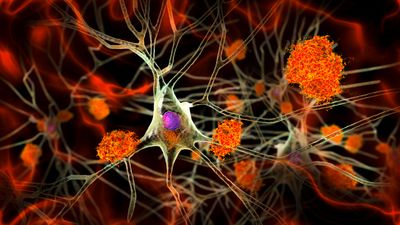
Now, the team is presenting a the results of a trial called ENACT, on which Engeland is senior co-author, in which they’ve found that the BrainHQ training can lead to a significant improvement in levels of amyloid beta (Aβ), one of the hallmarks of Alzheimer’s in the brain.
The randomized controlled trial involved 53 participants who either did the BrainHQ activities or other activities that many would consider to be “good” for the brain, like word searches.
After just 20 hours, the BrainHQ training cohort saw a significant improvement in something called the Aβ42/Aβ40 ratio, which is a well-established biomarker of Alzheimer’s disease.
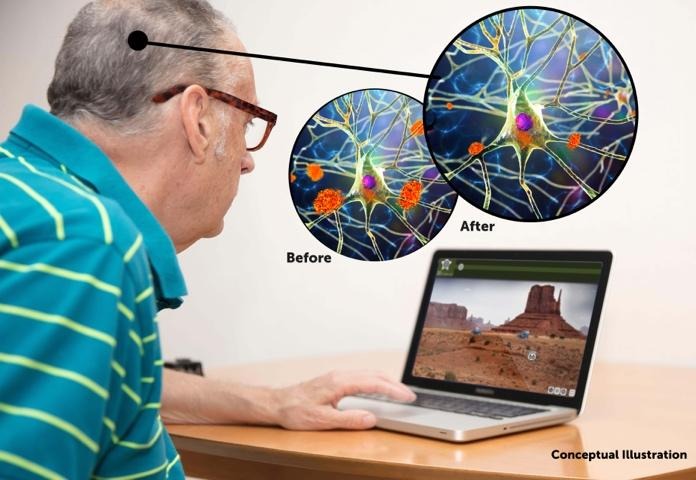
These new results look even more promising when taken together with those from the INHANCE study and another trial called ACTIVE.
In February 2026, 20-year follow-up results from this earlier trial of the type of brain training that BrainHQ uses were published. The authors found that people who had undergone the training had a 25 percent decreased likelihood of being diagnosed with Alzheimer’s disease and related dementias (ADRD) 20 years down the line.
“No prior cognitive training intervention has been shown to reduce risk of ADRD over a 20-year period,” they wrote in their paper.
“If you do a quick Google search ‘what can I do for brain health’, you’re going to see physical exercise, you’re going to see diet, and you’re going to receive some advice like ‘stay mentally active’,” Attarha told IFLScience.
“And I think just since October, first with INHANCE, then with the ACTIVE trial, and now with ENACT […] we’re learning more that the general guidance of just staying mentally active can be updated to [say] there’s specific forms of cognitive training that work for this purpose and other forms that do not.”
The evidence suggests there really is something different about BrainHQ. The same benefits have not been seen in these trials from things like playing solitaire or doing logic puzzles, Attarha and Engeland told us.
So, is it something we could all be doing?
Yes, was the resounding answer. Engeland said these exercises could become "something that is along the lines of personalized preventative medicine."
“This could just be made available to people, hopefully free of charge,” he said – including, Attarha adds, those in “rural communities, people who can’t travel to go see the clinician, people with memory concerns.”
Even in those with established dementia, or those with particularly high levels of amyloid already in their brains – such as people with rare, inherited forms of Alzheimer’s that Engeland told us can be thought of as “aggressive” – there could be a role for combining this kind of training with drug treatments.
“This is the approach that we take with other things, right?” Engeland points out. “Like depression, for instance. We don’t tend to only treat it pharmacologically. We tend to try to also have therapy as well, this sort of thing, and have combined effects.”
As Attarha put it, if the new generation of antibody drugs can help remove some of the amyloid buildup from the brain, the training could help repair some of the damage that’s already been done.
“You would use the training to rebuild the forest and the monoclonal body to remove the amyloid – the dead trees.”
If this has piqued your interest, you can try out a BrainHQ exercise daily for free.
The ENACT study was presented at the 2026 Alzheimer’s Association International Conference.