Nature
 PUBLISHED


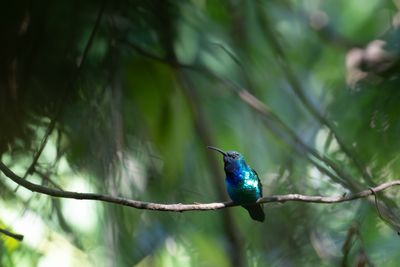


There are few things we enjoy hearing of more than a rediscovered species. Since the rare Santa Marta sabrewing (Campylopterus phainopeplus), a beautiful blue and green hummingbird, was unexpectedly rediscovered in 2022 after 64 years as a lost species, researchers have been studying this striking bird to learn more about this extremely rare population.
"The moment when I first found the Santa Marta sabrewing was very emotional, I really couldn't believe it. The adrenaline, the thrill of that moment of rediscovery, it's hard to fully describe just how exciting it was," said Yurgen Vega, one of the authors of a new study revealing insights into its range, habitat, and behavior, in a statement.
Since the rediscovery in the Sierra Nevada de Santa Marta mountains of northern Colombia in 2022, another research group found more individuals in different locations within the same broad area. The species was listed on the Search For Lost Birds and since being found, an international team has been monitoring these birds for the last two years.
The researchers monitored the behavior of these birds, learning that the species has year-round territories rather than migrating across the altitude as was previously thought. They also found that the birds have an extremely restricted range, only seen using four out of five known areas along the Guatapurí river basin.
“Our findings show that this amazing hummingbird may be an example of microendemism, as it seems to be restricted to a limited area within the world’s most important continental center of endemism,” said Esteban Botero-Delgadillo, lead author of the study and Director of Conservation Science with SELVA: Research for Conservation in the Neotropics.
The team also found out more about the ecology of the species, which suggests that the males form leks and aggressively chase intruders out of their territories. Looking closely at past historical records, and those from museums and Indigenous communities, they paint a clearer picture of the lives of these critically endangered hummingbirds. The proximity to the water seems an important point in the ecology of this species and the presence of riverbanks near the leks could indicate female nest sites, note the authors.
The researchers also highlighted what a collaborative effort the new knowledge took, and it was especially important to work with the local Indigenous communities who coexist with the hummingbirds.
“Unveiling the Santa Marta Sabrewing's story was not only possible through a joint effort between academia, local, and international organizations, but also by collaboration with the local Indigenous communities who coexist with the species," said Professor Carlos Esteban Lara of the Universidad Nacional de Colombia in a separate statement. "We are grateful for their help as our partnership and research continue to expand, to help implement conservation actions that benefit both the local people and the birds.”
The paper is available on the preprint server BioRxiV and has not yet undergone peer review.