Health and Medicine
 PUBLISHED
 6
6


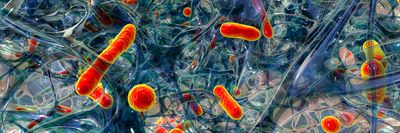


We’ll bet you didn’t have this on your 2026 bingo card. Scientists have been experimenting with using bacteria to eat cancerous tumors from the inside out, and – thanks to some clever genetic tweaks – it’s proving surprisingly effective. So much so, the authors of a new study say they hope to progress to preclinical studies in the not-too-distant future.
The bacteria that have been enlisted for this cancer-fighting quest are called Clostridium sporogenes. They usually live in soil, because they need an environment with no oxygen at all. As it turns out, the inside of a solid tumor – full of dead cells and starved of oxygen – is pretty much the perfect habitat for these microbes.
“Bacteria spores enter the tumour, finding an environment where there are lots of nutrients and no oxygen, which this organism prefers, and so it starts eating those nutrients and growing in size,” explained chemical engineering professor Dr Marc Aucoin, from the University of Waterloo in Canada, in a statement.
“So, we are now colonizing that central space, and the bacterium is essentially ridding the body of the tumour.”
That all sounds great, but you might have already spotted a problem. C. sporogenes need an oxygen-free environment. That’s fine inside the tumor, but what happens as the microbes start to eat their way to the surface and out into the body, where there definitely is oxygen?
The scientists have found a solution to this, and here’s where the genetic wizardry begins. First, they added a gene from another bacterium, C. aminovalericum, which can tolerate oxygen, to allow the bacteria to survive for longer as they reach the outer edges of a tumor. That achievement was the subject of a 2023 paper.
But it’s crucial that this doesn’t go too far. If the C. sporogenes are now perfectly happy to live and grow where there is oxygen, there’s nothing stopping them from colonizing bodily systems like the bloodstream – you may have dealt with the tumor, but you now have a whole new problem on your hands.
The new paper describes the ingenious method the scientists are trying get around this issue. It involves an innate ability that many bacteria naturally have, called quorum sensing.
Quorum sensing is a way for bacteria to communicate, to get an idea of the size of the colony in which they’re living, and to adapt their production of essential enzymes and other things the colony needs as a result. Individual bacteria produce chemical signals. As they multiply and the colony grows, with all of them producing these chemicals, the signal grows stronger.
The study explains how the team engineered the C. sporogenes with quorum sensing machinery from Staphylococcus aureus bacteria, using green fluorescent protein as a visual marker of successful integration of the system.
The authors write that the study “presents the first successful engineering” of this type of quorum sensing in an anaerobic bacterium like C. sporogenes. “Using synthetic biology, we built something like an electrical circuit, but instead of wires we used pieces of DNA,” said senior author Dr Brian Ingalls, a professor of applied mathematics at Waterloo.
The hope now is to combine the quorum sensing system with the oxygen tolerance genetic modification we talked about earlier. The aim would be to switch the oxygen resistance back on once the bacteria have done their job and eaten all the tumor, before they can go on to colonize other parts of the body.
Hungry Hungry Hippos: synthetic biology edition.
The study is published in ACS Synthetic Biology.