Nature
 PUBLISHED




Whether from a sense of adventure or existential dread, humans have long wondered whether alien life might exist somewhere in the universe. And here’s the punchline: it does – but it’s not on some distant planet. It’s right here.
“The ecosystem in the Ayalon Cave is unique in the world,” wrote Ariel Chipman, an associate professor at the Hebrew University of Jerusalem’s Department of Ecology, Evolution and Behavior, in a statement to the Israeli National Infrastructure Committee and Water Authority back in 2021.
“No other ancient system is known which is so exclusively concentrated on a foodweb disconnected from the [Earth’s] surface and sunlight.”
It’s an entire ecosystem that’s totally unique – not just odd, but fundamentally different from the rest of life on our planet. And even crazier: it was found basically by accident.
So: what on Earth happened in Ayalon cave?
A chance discovery
The Nesher Ramla quarry, near Haifa on Israel’s Mediterranean coast, has been a hub of activity for as long as humans have been in the area. Longer, potentially, if the more provocative interpretations of Nesher Ramla Homo turn out to be correct.
The story of Ayalon cave starts there – but it was either much later than that particular claim to fame, or far, far earlier.
It was 2006 when it appeared: a small hole in the quarry floor, left by one of the bulldozers excavating the local chalk. Spying what appeared to be a lake hidden within, Matan Avital, a teenager on a post-high-school year of service at the Society for the Protection of Nature in Israel and the Israel Cave Research Center, volunteered to climb inside.
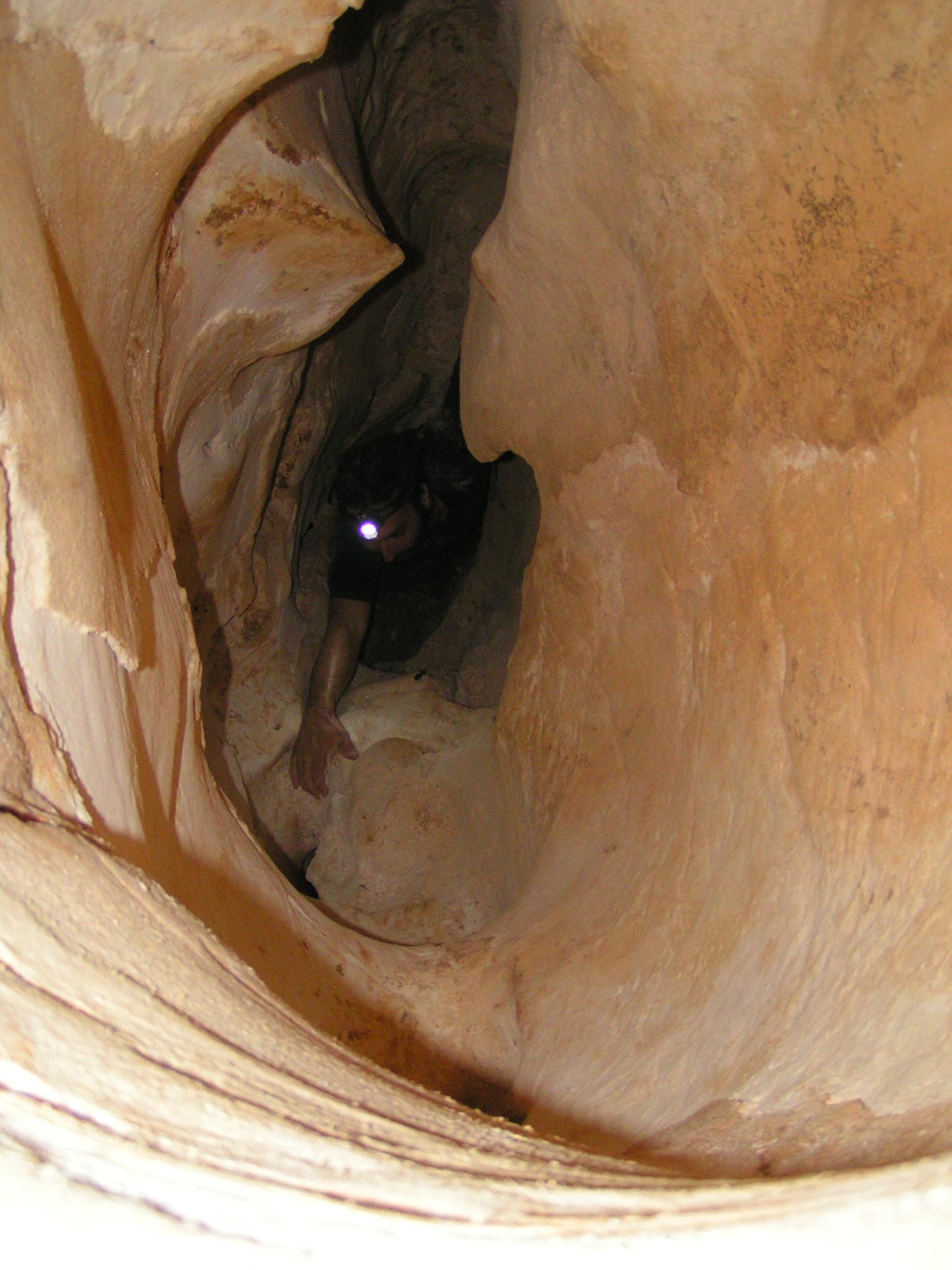
"I went down to check [it] out,” Avital said at the time, “when I noticed there were tiny animals swimming around in the water. We managed to catch one, and when we showed it to the experts, they said they had never seen anything like it before. It was a totally new animal.”
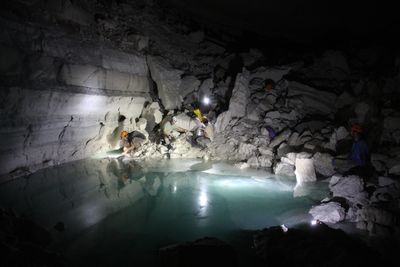
It was enough for the cement manufacturer operating the quarry to cease digging – at least for a while – so that the professionals could take a closer look. “We felt like astronauts who had landed on the moon,” Amos Frumkin, a professor in the Hebrew University’s Geography Department, told Haaretz at the time. “[We were] in a place where no human foot had ever stepped.”
It wasn’t an exaggeration. The cave had been cut off from the terrestrial world for tens of millions of years, without even indirect access to sunlight, rainwater, or any of the other factors usually considered fundamental to life.
And yet, somehow, some species thrived.
Life in the dark
Frumkin and his colleagues would eventually find eight previously unknown species of animal inside the cave: four crustaceans and four terrestrial animals. None had eyes or pigmented bodies – what use would they be in an eternally unlit cave? – and all existed within an ecosystem completely removed from sunlight and photosynthesis.
It shouldn’t be possible. But, while the new species were obviously unlike anything else known to science, a closer inspection showed that they perhaps weren’t as alien as first thought, either.
“Typhlocaris species are ‘living fossils’,” explained Tamar Guy-Haim, a researcher at the Israel Oceanographic and Limnological Research and lead author of a 2018 paper detailing the similarities between Typhlocaris ayyaloni – the subtype found in Ayalon cave – and two other known cave shrimps from elsewhere in the world.
“[They are] remnants of an ancestor shrimp species that existed in the ancient Tethys Sea, millions of years ago,” she said in a statement at the time. “They have survived since then under isolated conditions in a unique ecological system, cut off from the external environment.”
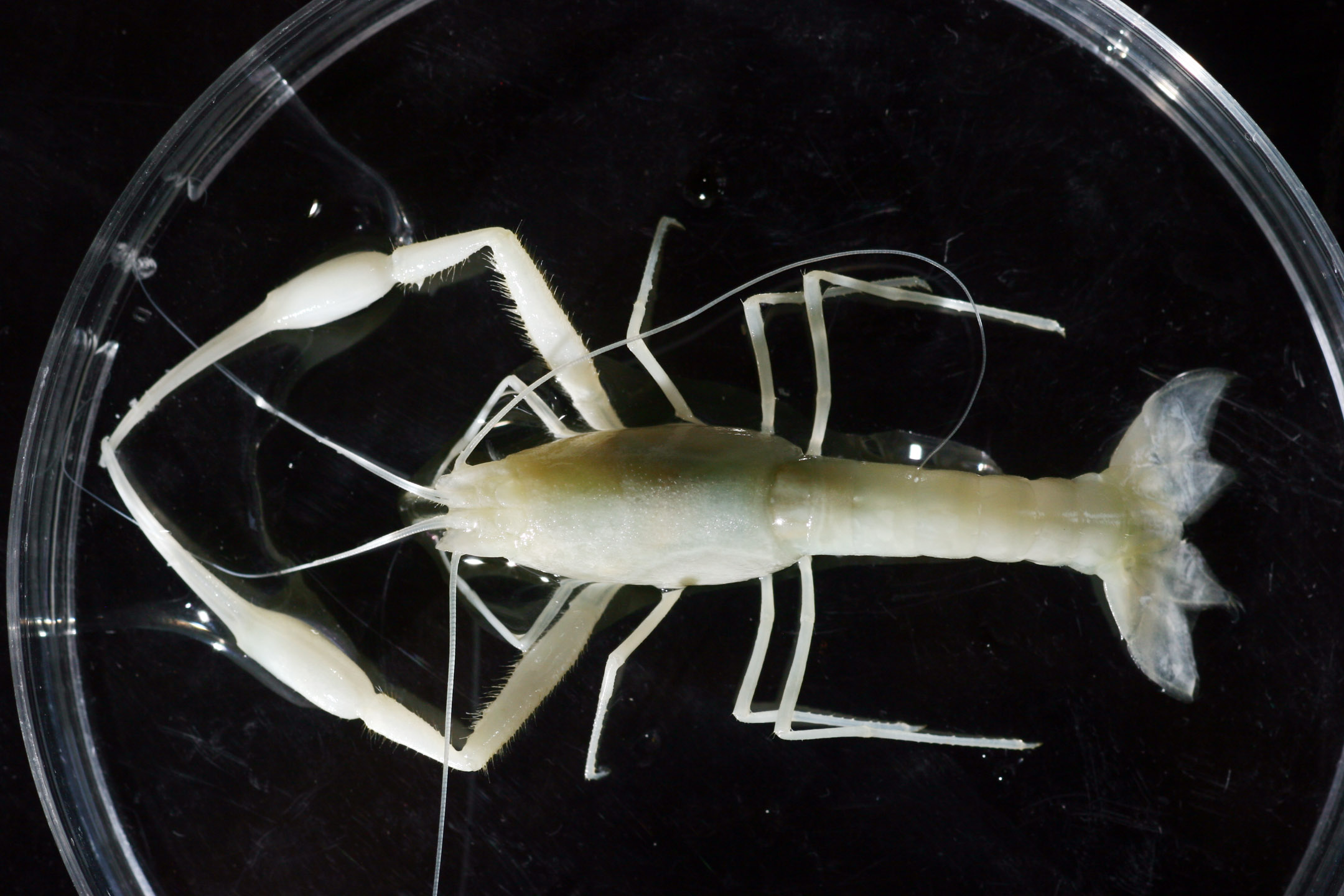
This isolation led to the Ayalon shrimp being notably different from its cousins – though, slightly surprisingly, it was more closely related to the species found in Italy than just down the road in the Jordan Valley. But it was still the same kind of animal – and it joined the crustacean Tethysbaena ophelicola, the silverfish Lepidospora ayyalonica, and two species of Metacyclops (a crustacean, not, as the name suggests, one of the X-Men) as being new variants of known genera.
But other species were weirder. A scorpion, dubbed Akrav israchanani in honor of its location – akrav is the Hebrew word for scorpion – and its discoverers Israel Naaman and Hanan Dimentman, was found to be a brand new genus, albeit an apparently already extinct one: “The most interesting and bizarre aspect of this find was that, unlike other aquatic and terrestrial organisms found in Ayyalon Cave, all scorpion specimens found in the cave were dead,” reported one 2011 paper on the species.
With the false scorpion Ayyalonia dimentmani – also a new genus – and a springtail that nobody seemed sure how to classify, that made eight species previously unknown to science. But as exciting as that might seem, it wasn’t the headline find for scientists at the time.
“The sensation is not the new species,” Dimentman told Haaretz. “[It’s] the discovery of a very ancient cave, completely cut off from the outside, where you can see animals in their habitat.”
Unusual foundations
For having been hidden for so long, Ayalon is not small. “We were especially surprised by a room 30 meters [98 feet] high with a diameter of 40 to 50 meters [131 to 164 feet], with an underground lake,” Frumkin told Haaretz back in 2006; in total, the cave was about 2.5 kilometers (1.6 miles) long and extended 100 meters (328 feet) deep, making it the third-largest limestone cave in the country.
And everything inside – from the water to the life-forms – was unique. Having been sealed off from the world by a thick and impermeable layer of chalk, the water within couldn’t have come from rain or the nearby Mediterranean: testing would later show that it originated from sources deep underground, giving it a unique and highly stable temperature and chemical composition.
But this extreme isolation meant something more than just strange water and animals. Without sunlight, photosynthesis could never occur within the cave – so the bacteria that formed the very base of the ecosystem had to figure something else out. Rather than drawing energy from the sun, “the unique faunal assemblage utilizes chemosynthetic food web based upon H2S within the ascending plumes of hydrothermal water,” reported one 2022 paper.
“This ecosystem depends on biomass production by autonomous energy basis,” it explained. “This is utilized by chemoautotrophic sulfide-oxidizing bacteria that are found there in great masses.”
In other words: they derive energy by creating tiny chemical reactions in the water, taking electrons from hydrogen sulfide and leaving behind less energetic sulfate molecules. It’s not the only place in the world where this kind of thing can be found, but similar ecosystems number in the single digits – and all known examples so far are very different even from one another, let alone the world at large.
That makes Ayalon cave “a unique phenomenon on a global scale,” announced the Israel Nature and Parks Authority in 2021, as reported by The Times of Israel. “The cave was formed and continues to form due to specific conditions of groundwater. The entire ecosystem relies on primary sulfur-assisted production under oxygen-free conditions.”
A near miss
After surviving for 14 million years underground and undisturbed, it took only one for Ayalon Cave’s pristine biome to face destruction.
First, it was accidental. “We have documentation of the entrance of invasive species that weren’t in the cave before, including bats and a species of small crab,” Frumkin reported in 2021. “The original animals are disappearing.”
But later, it became pointed. In 2021, Israel’s National Infrastructure Committee and Water Authority was looking for a place to direct surface runoff water to in the winter – and they thought the Nesher Ramla quarry seemed the perfect place.
Scientists were in uproar. “Surface runoff water is completely different from the groundwater that serves as the basis of life in the cave,” Frumkin told The Times of Israel, “and entry of the former, in quantities three orders of magnitude greater than the latter, would be certain to destroy this unique ecosystem.”
So too were groups such as the Israel Union for Environmental Defense, several international bodies, and the Nature and Parks Authority. There were public petitions against the move, and experts pled their case in the media.
It was a strong defense – but would it be enough against the immense power of industry?
In the end, it was. While it fell short of the Nature and Parks Authority’s aims of the declaration of Ayalon cave as a nature reserve, the the National Infrastructure Committee did eventually back down from its plans. It was a decision that would help “prevent harm to the Ayalon Cave and its unique ecosystem,” Frumkin told Israel Hayom after the announcement, and “we hope that environmental considerations will continue to guide government and public authorities in Israel and lead to a higher-quality world for us to leave to future generations.”
“We thank everyone who took part in the fight,” he said, “and the public who supported it.”