Thank you!

We have emailed you a PDF version of the article you requested.

Can't find the email?

Please check your spam or junk folder

You can also addnewsletters@iflscience.comto your safe senders list to ensure you never miss a message from us.

IFLScience Home
IFLScience logo

Audubon Photography Awards Release The Best Entries Of Birds Chowing Down And They're Hilarious

Complete the form below to listen to the audio version of this article


You can unsubscribe at any time. View ourprivacy policy and terms below.

IFLScience needs the contact information you provide to us to contact you about our products and services. You may unsubscribe from these communications at any time.

For information on how to unsubscribe, as well as our privacy practices and commitment to protecting your privacy, check out ourPrivacy Policy

Ad

IFLScience Home
IFLScience logo

Support Science Journalism

Become a member

SUBSCRIBE

Support Science Journalism

Become a member

SUBSCRIBE
  • account

    ACCOUNT

  • astronaut

    SIGN IN

  • exit

    SIGN OUT

search

Search

  • more-iconclose moreTopics
    • Humans
    • Health & Medicine
    • Nature
    • Space & Physics
    • Technology
    • Culture & Society
  • Latest
  • Trending
  • Video
  • Podcasts
  • Events
  • NewsLetters
  • Magazine
  • more-iconclose moreMore
    • Features
    • eBooks
    • About Us
  • The vault

Support Science Journalism

Become a member

SUBSCRIBE
  • trending-iconTrending
  • clock-iconLatest
  • more-iconclose moreTopics
    • Humans
    • Health & Medicine
    • Nature
    • Space & Physics
    • Technology
    • Culture & Society
  • Features
  • Video
  • Podcasts
  • Events
  • NewsLetters
  • Magazine
  • more-iconclose moreMore
    • eBooks
    • About Us
  • THE VAULT
  • Sign Out
  • Support Science Journalism

    Become a member

    UPGRADE
  • account

    MY ACCOUNT

  • exit

    SIGN OUT

  • account

    MY ACCOUNT

  • THE VAULT

  • MAGAZINE

  • exit

    SIGN OUT

nature-iconNature
clock-iconPUBLISHEDJanuary 10, 2019
comments icon4

Audubon Photography Awards Release The Best Entries Of Birds Chowing Down And They're Hilarious

Madison Dapcevich headshot

Madison Dapcevich

Madison Dapcevich headshot

Madison Dapcevich

Freelance Writer and Fact-Checker

  • email

Madison is a freelance science reporter and full-time fact-checker based in the wild Rocky Mountains of western Montana.

BookView full profile


BookRead IFLScience Editorial Policy

  • twitter-icon

Freelance Writer and Fact-Checker

Madison is a freelance science reporter and full-time fact-checker based in the wild Rocky Mountains of western Montana.View full profile

Madison is a freelance science reporter and full-time fact-checker based in the wild Rocky Mountains of western Montana.

View full profile
article image

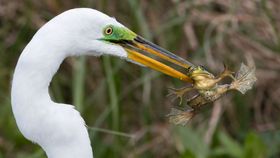
Found in both salt and freshwater, Great Egrets feed on aquatic animals – like this leaping frog – that make their home in wetlands, ponds, tidal flats, and other areas. Peter Brannon/Audubon Photography Awards

SHARE

FOLLOW

Follow on google news iconGoogle prefered source badge

In the latest release of the Audubon Society's bird-nerd photos, we're given a glimpse into the predatory realm of our flying, feathery friends and let's just say we have never been more happy to be at the top of the food chain. 

The rest of this article is behind a paywall. Please sign in or subscribe to access the full content.

The photos were released as part of the nonprofit conservation organization's annual photography competition, and even though these images didn't necessarily take home the grand prize, they remind us just how eclectic and unique the avian world truly is. As Audubon notes, birds need to eat a lot in order to survive – we can only imagine how tiring flying around can be. For many species, that means fueling up requires eating as much as one-third of their body weight every day. Dainty little hummingbirds might eat up to 100 percent of their body weight in nectar alone, while the medium-sized Cooper's Hawk eats around 12 percent of its weight each day. For a human weighing around 68 kilograms (150 pounds), that's the equivalent to 8 kilograms (18 pounds) of grub, about 48 cheeseburgers. 

Not to mention, the diet of our avian amigos is quite the nature-inspired buffet. In 2018, photographers from around the world captured birds eating everything from fish to frogs and lizards to starfish – even other birds (oops). 

So, grab your lunch and take a few minutes to yourself to admire the wonderful world of predatory birds. Though you may lose your appetite and there may be terrible puns (you are warned), we promise it'll be worth it. 

I regret nothing...

Herring gull. Photo: Christi Herman/Audubon Photography Awards

It's tough being an owl by oneself. We're sure that's why this northern pygmy owl below was captured toting around their little rodent friend, right? 

Northern pygmy owl. Pierre Cenerelli/Audubon Photography Awards

Speaking of little buddies, this majestic peregrine falcon was also spotted palling around with its buddy, the common grackle. Hawkward...

Peregrine falcon and Common Grackle. Scott Dere/Audubon Photography Awards

 No (r)egrets about this move. 

Reddish egret. Tim Timmis/Audubon Photography Awards

At least wait for your tern! Clearly, nobody taught these two table manners. 

Least terns. Anja Trepper/Audubon Photography Awards

Most animal puns quack us up, but this one is just morbid. 

Snowy owl with red-breasted merganser. Matthew Booth/Audubon Photography Awards

 Are you puffin' kidding me, bro?

 
Atlantic puffins. Krisztina Scheeff/Audubon Photography Awards

Hey, I'm walking here. 

Purple gallinule. Tina Wright/Audubon Photography Awards

And don't forget that the 2019 Audubon Photography Awards are currently open for submissions! You can submit your best bird photos here. 


clock-icon
ORIGINALLY PUBLISHEDJanuary 10, 2019

Written by Madison Dapcevich

SHARE

FOLLOW

Follow on google news iconGoogle prefered source badge

Add us as a Google preferred source to see more of our
trusted coverage in Search


nature-icon

More Nature Stories

link to article

In 1822 A Stork With A Spear Through Its Neck Landed In The Village Of Klütz In Germany, And Changed Ornithology ForeverPfeilstorch: A stork with an arrow protruding through its neck.
nature-iconanimals

In 1822 A Stork With A Spear Through Its Neck Landed In The Village Of Klütz In Germany, And Changed Ornithology Forever

clock-icon11 hours ago

link to article

It's Official: NOAA Declares El Niño Is Here, With 63 Percent Chances Of It Being A Big OneEl Niño impact on weather, stormy skies and flooding
nature-iconenvironment

It's Official: NOAA Declares El Niño Is Here, With 63 Percent Chances Of It Being A Big One

clock-icon11 hours ago

link to article

These Tiny Birds Are Evolving Into "Giants" After Being Isolated On Nearby Islands Eurasian wren (Troglodytes troglodytes)  can weigh less than a coin.
nature-iconanimals

These Tiny Birds Are Evolving Into "Giants" After Being Isolated On Nearby Islands

clock-icon11 hours ago
video-icon

Multimedia

link to article

Should You Clone Your Pet? Find Out More In Issue 47 Of CURIOUS – Out NowThe cover of IFLScience's CURIOUS magazine as shown on an iPad. The background is a pop art-style illustration of a dog. The cover line in white says “should you clone your pet?”

Should You Clone Your Pet? Find Out More In Issue 47 Of CURIOUS – Out Now

link to article

Are There Plants That Can Photosynthesize By Moonlight? | IFLScience We Have QuestionsIn the foreground, an episode of IFLScience We Have Questions plays on a smart phone. In the background, there is a full Moon at night, and there are also plants growing from soil at the bottom and leaves from the top of the image.

Are There Plants That Can Photosynthesize By Moonlight? | IFLScience We Have Questions

link to article

Do Other Animals Have Pets? Find Out More In Issue 46 Of CURIOUS – Out NowThe cover of IFLScience's CURIOUS magazine as shown on an iPad. The background is light blue, with an illustration of an elephant with a mouse sitting on top of its head and next to the elephant, a fish in a fishbowl. The cover line in white says “do other animals have pets?”

Do Other Animals Have Pets? Find Out More In Issue 46 Of CURIOUS – Out Now

More Multimediamore-icon
IFLScience Home
IFLScience logo
FacebookFacebookFacebookInstagramYouTubeYoutubeRSSRSS
The
IFLScience Home
IFLScience logo
Newsletter

Receive weekly science coverage direct to your inbox

Navigation

  • Home
  • Team
  • About
  • Careers
  • Subscribe
  • Company & Product Insights

Contact

  • Contact
  • Write For Us
  • Submit News
  • Advertise With Us
  • FAQs & Support

Editorial

  • Editorial Mission
  • Correction Policy
  • Comment Policy
  • Transparency Policy
  • Fact-Checking Policy

Legal

  • Terms Of Use
  • Cookie Policy
  • Privacy Policy
  • Advertising Policy
  • Corporate Social Responsibility
  • Change Cookie Settings
  • Do Not Sell
  • Manage Push Notifications

© 2026 IFLScience. All Rights Reserved. RSS