Space and Physics
 PUBLISHED
 1
1


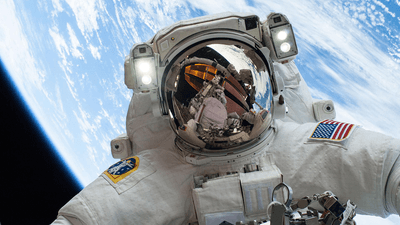


Astronauts will soon be able to phub each other in space, after NASA Administrator Jared Isaacman announced that they will be able to take their phones on future missions.
Historically, NASA hasn't had to deal with the issue of astronauts taking their phones, given that the space agency predates the invention of the cell phone. But for later missions, when cell phones have been an option, astronauts have so far been left using official channels for communication with back home. They use NASA's Space Network, relaying signals off communication satellites to and from Earth.
"Before the Space Network, NASA astronauts and spacecraft could only communicate with the support team on Earth when they were in view of an antenna on the ground. That allowed only for communications less than 15 minutes every hour and a half," NASA explains of the network. "Imagine if our cell phones worked that way. It would be difficult to stay in contact with family and friends or respond to important messages. The Space Network provides near continuous communications coverage every single day."
While astronauts are able to use this network to communicate with home, Isaacman has announced that the next crew headed to the ISS, and the astronauts destined to head around the Moon on Artemis II, will be allowed to take their phones with them.
"NASA astronauts will soon fly with the latest smartphones, beginning with Crew-12 and Artemis II," Isaacman wrote on X. "We are giving our crews the tools to capture special moments for their families and share inspiring images and video with the world."
Astronauts have been allowed to take cameras with them since the early days of the space program, though at first there was a little concern that other nations would see photos taken from orbit as an act of ill will, or even war. As well as this, during the very early days, NASA had other more pressing concerns.
"When John Glenn became the first American in orbit, bringing a camera was an afterthought. An Ansco Autoset 35mm camera, manufactured by Minolta, was purchased in a local drug store and hastily modified so the astronaut could use it more easily while in his pressure suit," NASA explains. "At the time, everything that John Glenn did was deemed an experiment. At the beginning of the program, no one knew for certain whether weightlessness would prevent a man from seeing, or from breathing, or from eating and swallowing. Photography was deemed nothing more than a recreational extra."
With the change of policy, phones will be available for astronauts to take photographs, as well as communicate with Earth. On top of this, the move should allow astronauts to get better cameras on board, with a sped-up process for approving hardware for use on NASA missions.
"Just as important, we challenged long-standing processes and qualified modern hardware for spaceflight on an expedited timeline," Isaacman added. "That operational urgency will serve NASA well as we pursue the highest-value science and research in orbit and on the lunar surface. This is a small step in the right direction."
As of yet, it is unclear which phones have been approved for use in the upcoming missions. But soon, astronauts will be able to phub each other (or ignore each other in order to look at their own phones) to their heart's content. With phones potentially aboard Artemis II, we may even get our first phubbing from beyond the orbit of the Moon.