Space and Physics
 PUBLISHED
 2
2


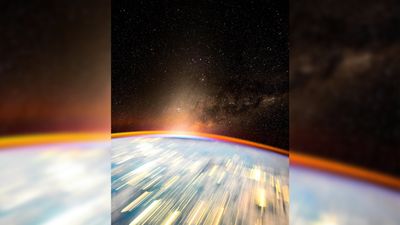


Astronaut Don Pettit has taken one of the most incredible astrophotography pictures ever, and possibly the best taken by humans from the International Space Station (ISS). The latest composition is a visual symphony of cosmic, terrestrial, and technological objects captured as the space station speeds around our planet at 8 kilometers (5 miles) per second.
In a single photo you can see: The Milky Way, zodiacal light, a streak created by Starlink satellites, an incredible number of stars, the emission of hydroxyl at the edge of the atmosphere, a prelude to dawn, and the lights of many cities as the station zips over them.
Before discussing the absolute technical feat that is the image, one beautiful detail we want to stress is the angle between the zodiacal light and our galaxy. The light is caused by sunlight reflected by dust grains within the orbital plane of the Solar System. That’s roughly the plane where the planets more or less orbit. Look at how much it is inclined compared to the plane of the Milky Way. The Solar System travels the galaxy slanted!
The photo has been described by astrophotographer Andrew McCarthy as “the best astrophoto ever captured from the ISS”. And it is hard to disagree. It doesn't just look incredible, it requires technical ingenuity and dedication from Pettit. Astronauts have talked about just how many stars you can see in space, but capturing them has always been a challenge.
Both human and robotic missions tend to focus on specific objects, and to take good pictures of them, you need a high shutter speed and short exposure. Whatever your object is – a planet, a moon, an asteroid – it will be brighter than the dim stellar background.
It is certainly possible to photograph stars in space, you just need to take on board the fact that the light conditions are somewhat peculiar. Look at the image again, that is the night side of Earth and yet it is very bright.
The final bit of kit you need is something that compensates for the speed. The ISS needs to move fast to stay in orbit: that’s the only way for it to keep falling to the ground but missing it! Pettit developed his own star-tracker device that can deliver exposures that last many seconds without creating star trails. The cities though, they are blurry!
Pettit has raised the bar for the kind of photos one can take in orbit.