Space and Physics
 PUBLISHED
 16
16


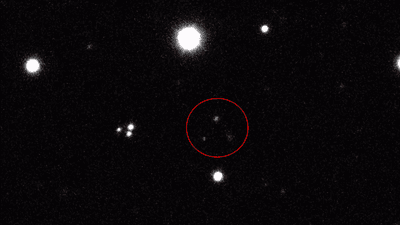


Astronomers are getting prepared for the chance to see "the most energetic lunar impact event ever recorded in human history", which will take place in 2032, with a little luck.
Asteroid 2024 YR4 was first discovered on December 27, 2024, by the Asteroid Terrestrial-impact Last Alert System (ATLAS) telescope in Chile. Initial observations showed around a 1 percent chance that it could collide with Earth on December 22, 2032, while follow-up observations of the asteroid briefly showed a slightly higher chance of the asteroid making an impact. At 3.1 percent, it briefly became considered the most dangerous space object since tracking began, prompting "city-killer asteroid" headlines at the time.
Follow-up observations, as was expected, brought the odds down significantly of Earth impact to basically zero. But after follow up observations by the JWST and analysis by NASA's Center for Near-Earth Object Studies at JPL, NASA placed the odds of the asteroid hitting the Moon at around 4.3 percent.
"The odds of an impact into the Moon have always been there. It's been lower at that time because the Earth [was] a bigger target," planetary scientist Dr Andrew Rivkin, from Johns Hopkins University in Maryland, told IFLScience back in April 2025.
"The way that the orbit improved made the position move away from the Earth, but it moved toward the Moon. So there's like almost a 4 percent chance it's going to hit the Moon. That means there's a better than 96 percent chance it's going to miss the Moon, but if it did hit the Moon, it really would be pretty spectacular!"
That would be understating it.
"Such an impact, with equivalent kinetic energy of ∼6.5 Mt TNT," the authors of a new paper, which has not yet been peer reviewed, explain, "is expected to produce a ∼1 km [0.6-mile] crater on the Moon, and will be the most energetic lunar impact event ever recorded in human history."
"Historical Apollo seismometers recorded even the ∼1 kT TNT-equivalent impact of the Apollo 13 S-IVB stage at global distances, implying that a 2024 YR4-sized collision would produce seismic signals readily detectable across the Moon," they added.
A lunar impact, of course, would not be risk-free.
"If 2024 YR4 strikes the Moon in 2032, it will (statistically speaking) be the largest impact in approximately 5,000 years," authors of a previous paper explained. "We estimate that up to 108 kg of lunar material could be liberated in such an impact by exceeding lunar escape speed."
Lunar material from the impact could cause meteor showers on Earth. While meteorites making it to the Earth are not ruled out, the main risk of an impact to Earth operations is for our satellites orbiting the planet encountering the debris.
But risk aside, it could be pretty exciting. In the new paper, scientists attempted to model what will happen if the asteroid does impact the Moon, and proposed timelines for observations of it.
"Our results suggest an optical flash of visual magnitude from -2.5 to -3 lasting several minutes directly after the impact, followed by hours of infrared afterglow from ∼2,000 K molten rock cooling to a few hundreds K," the team explains in their paper. "The associated seismic energy release would lead to a global-scale lunar reverberation (magnitude ∼5.0) that can be detectable by any modern seismometers."
According to the team, the impact would cause a reasonable amount of material to be ejected from the Moon, depending on where the asteroid struck. Ignoring risk to Earth and our satellites for now, this could actually be pretty cool.
"[T]he year following the 2024 YR4 impact offers a unique window to monitor tens to hundreds of observable meter- and sub-meter-sized lunar ejecta," the team explains. "Crucially, the majority remain bound to Earth, implying close proximity and low relative velocities."
In these circumstances, the team suggests that the debris could be used to test planetary defense technologies, such as testing how impacts affect the objects, or capturing and moving the objects into a stable orbit, storing them there for later retrieval.
In practical terms, the team suggests that global amateur networks and telescopes in Hawai'i have the best opportunity to observe the initial impact.
"The predicted impact on 2032-12-22 occurs when the Moon is waning gibbous (∼70 percent illumination). Geometry analysis shows that the southern impact corridor will be visible across the Pacific hemisphere of Earth," the team explains. "In particular, the Mauna Kea observatories [...] will enjoy optimal visibility with the Moon high (∼80°) above the horizon and local pre-dawn darkness."
The team agrees with previous findings that ejecta from the Moon could reach lunar escape velocity – 8,552 km/h (5,315 mph) – and temporarily populate the space between the Earth and the Moon, with potential threat to our satellites. According to the team, 107–108 kilograms of material could be ejected, ranging from millimeter-sized meteoroids to meter-scale boulders. Material that makes it to Earth would fall across all latitudes, with some falling on Antarctica, historically a great place to recover meteorites.
There are still very low odds of collision, but if it does happen it could be as interesting as it is hazardous.
"If the predicted collision indeed come up, 2024 YR4 will offer a once-in-a-generation opportunity to observe, in real time, the interplay between impact dynamics, lunar geology, and near-Earth space environment, providing crucial benchmarks for planetary-defense modeling and future lunar science," the team concludes.
The paper is yet to be reviewed and has been posted to preprint server arXiv.