Nature
 PUBLISHED


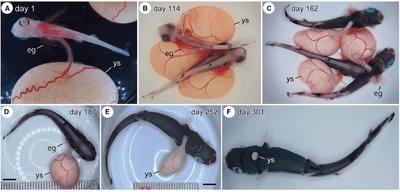


Scientists in Japan have created an artificial womb that can incubate prematurely delivered shark embryos until they are ready to be born.
A team of researchers at the Okinawa Churaumi Aquarium in Motobu built an artificial system that was able to incubate the embryos of slendertail lantern sharks (Etmopterus molleri) for up to 355 days, significantly longer than their previous record of 160 days
Their freshly tweaked process allowed a few of the mid-term embryos to grow from 3 to 15 centimeters (1.2 to 5.9 inches), which is around their natural birth size.
Premature sharks are especially vulnerable when they’re born because the seawater is too salty for their fragile bodies. It is perilous for viviparous sharks (that give birth to live young) as they don’t have a protective shell to shield them from the outside environment.
To overcome this problem, the key was to develop an artificial uterine fluid that had a similar osmotic pressure and salinity to the shark blood plasma. The system also gradually changed the chemical composition of the fluid in the fake womb; decreasing the proportion of artificial uterine fluid from 100 to 75, 50, 25, 12.5, and 6.3 percent in volume, while increasing the seawater from 0 to 25, 50, 75, 87.5, and 93.7 percent.
It worked – although not perfectly. Just three of the 33 embryos reached birth size. The surviving trio is fit and healthy, though. Upon being released from the artificial uterus, they were given a meal of minced mackerel and shrimp, and began to behave much like any “normal” baby shark.
The sharks are now healthy adults living at Okinawa Churaumi Aquarium and appear no different from their natural-born peers, according to Haiku Magazine.
“In our aquarium, as in the outside world for conservation, we cannot select the species we receive. The reproductive systems of sharks have great diversity, and I think our system can only apply to about half of viviparous sharks. We would like to develop more universal systems,” Taketeru Tomita, lead study author and researcher at Okinawa Churashima Foundation, told the magazine.
In recent years, scientists have dabbled with artificial wombs for other species – including mammals. In 2017, two separate teams of researchers developed two different artificial wombs that grew a preterm lamb in a bag. As creepy as it may seem, the groundbreaking research could someday help save the lives of human babies that are born extremely prematurely.
The study is published in the journal Frontiers in Fish Science.

 1
1