Nature
 PUBLISHED
 1
1


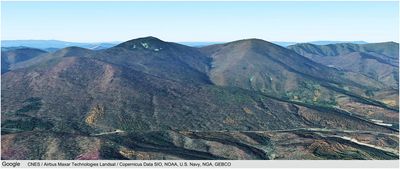


Untold millions of years ago, a meteorite fell from the sky and hit a mountain range in northeastern China, causing it to split into two peaks. New research claims reveal the structure of the impact site for the first time.
The crater is located in Jilin province, near China’s border with North Korea. The impact was so large, around 1.6 kilometers (1 mile) wide, that it left two mountain peaks, which are known as Front Baijifeng and Rear Baijifeng.
Historically, the evidence for meteorite impacts in China has been quite low compared to other parts of the world. But rock fragments identified at Baijifeng Mountain caught the interest of researchers at the Center for High Pressure Science and Technology Advanced Research in Shanghai.
The team, led by Ming Chen and Ho-Kwang Mao, were attracted by odd sandstone rocks locally referred to as “celestial stones”, which had unknown origins. However, through their analysis, Chen and Mao found something surprising – the name is more than apt.
“We set out to find out the real story behind this accumulation of rock fragments”, the authors write. “Our investigation has revealed for the first time the presence of an impact structure on Baijifeng Mountain.”
The rock fragments are made of sandstone and granite, both of which contain small quartz minerals. When struck by heat and pressure, quartz can deform in specific ways. These deformations, the authors explain, are “widely accepted as diagnostic evidence for shock metamorphism and terrestrial impact structures.” Essentially, “shock metamorphism” in quartz can indicate meteorite impact sites.
“During the impact cratering,” they add, “a large amount of rock would have been excavated and ejected to form this new geological structure. The collision would have greatly changed the original terrain of the target, forming two new peaks, namely, Front Baijifeng and Rear Baijifeng.”
According to the authors, the granite in the crater was formed between 150 and 172 million years ago, during the Jurassic Period. If a meteorite did hit the mountain, then it must have done so after this period. Unfortunately, the exact timing remains unknown, though the authors suggest it could be much later.
This is based on a comparison of the Baijifeng site with one of the few other impact sites in China – the Yilan crater in Harbin, Heilongjiang Province. This crater was formed around 49,000 years ago and is the largest known impact crater that is less than 100,000 years old, per Live Science.
According to Chen and colleagues, the Yilan crater has been strongly weathered in ways that are comparable to Baijifeng, which means the age of the latter “should not be far from that of the Yilan impact structure.”
Nevertheless, further work is needed to confirm when the falling celestial stone caused such incredible changes to the mountain face.
“The Baijifeng cirque-shaped depression is a well-preserved impact structure with unique morphological characteristics, and its location at the top of a high mountain creates spectacular natural scenery” the authors conclude.
The study is published in Matter and Radiation at Extremes.