Nature
 PUBLISHED


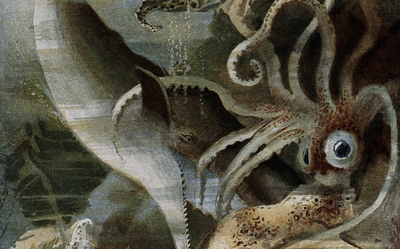


In the darkest depths of the ocean, a battle has been unfolding for millions of years: whales versus squids. Both animals have become highly specialized masters of the deep sea, shaped in part by an evolutionary “arms race” that has pushed two of Earth's most intelligent creatures to extraordinary extremes.
Toothed whales, such as beaked whales and sperm whales, are highly effective hunters of deep-sea cephalopods. Evidence of these underwater dogfights is written across their hulking bodies, which are often covered in sucker marks and scars from run-ins with squids, as well as in the masses of cephalopod beaks that accumulate in their stomachs.
This rivalry, however, is a relatively recent development. For most of their 530-million-year history, cephalopods evolved to evade predominantly visual predators, such as fish, that use sight to hunt.
It wasn’t until 34 million years ago that the predatory toothed whale entered the waters. To navigate the pitch-black depths, these whales developed echolocation, a biological sonar that uses soundwaves to perceive the surrounding world. Some scientists have speculated that whales evolved this ability specifically to hunt squid near the surface at night. As this ability became increasingly refined, it allowed the whales to scan vast volumes of water, detecting their next dinner from hundreds of meters away.
The threat of echolocating whales imposed “strongly different selective pressures” on cephalopods and sparked a “deep-sea arms race,” in the words of a 2024 paper.
The squids could no longer rely on color-changing tricks to avoid being eaten, plus they are effectively “deaf” to the echolocation frequencies. Their pre-existing adaptations to evade hunters had become desperately outdated.
Faced with new pressures, the cephalopods slowly transformed. Some developed elongated, slim bodies to minimize their acoustic cross-section, making them harder for whale sonar to detect at long range. Others were also influenced to live solitary lives, since hanging out in groups (schooling) made them more vulnerable to acoustic detectability.
The squids also pushed their range closer to the seabed, deeper into the abyss. Whales are marine mammals, after all, so they must return to the surface for oxygenated air periodically. The deeper squids go, the trickier things become for the whales.
Toothed whale predation may have also have been a driver of the deep-sea cephalopods’ “live-fast-die-young strategy,” the 2024 paper explains. They tend to grow quickly, aren’t picky with mates, and die young – a smart tactic if you’re keen to pass on genetic material, by any means possible, in the face of grave danger.
But it takes two to tango. As squids dispersed, hid, and developed new game plans, whales adapted in turn. Deep-diving toothed whales are social beings, but when they hunt in the deep, they spread out and forage individually while remaining loosely synchronized. This strategy allows a group to search enormous areas efficiently, sharing information without relying on herding or chasing schools of prey.
Even the massive size of whales might in part be a reflection of this “arms race.” A larger body volume enables higher oxygen stores and resilience to temperature gradients, allowing them to dive deeper for longer.
The back-and-forth goes on and continues to this day. While we won't see the next chapter of this war in our lifetime – evolution moves at a glacial pace compared to human history – the battle continues, thousands of feet below the waves. The only question is whether the "arms races" of our own species will allow us to remain around long enough to see how it rolls on.