Nature
 PUBLISHED





The temperature of Earth’s atmosphere and oceans has been slowly but surely cranked up since the 19th century – except for one small patch of sea just south of Greenland and Iceland. Against all odds, this "cold blob" in the North Atlantic has actually been cooling over the past 150 years, much to the interest and confusion of the scientific community.
Now, a new study argues that the unexpected cooling may be linked to the weakening Atlantic meridional overturning circulation (AMOC), the mega highway of ocean currents that shifts heat, carbon, and nutrients across the Atlantic Ocean.
The AMOC sends warm, salty water northeast from the Gulf of Mexico across the Atlantic, where the cold northern waters chill it into sinking and send it back south along the ocean floor to complete the loop. In recent years, a stream of evidence has suggested that the AMOC may be losing its strength as a result of human-caused climate change.
As global temperatures rise, melting ice sheets in Greenland are flooding the North Atlantic with fresh water, disrupting the delicate balance of salt and density that keeps the "conveyor belt" running. If this system collapses – which is a deeply worrying possibility – the consequences would be catastrophic.
The “cold blob” in the North Atlantic is a prime location to receive that balmy warmth from the south, so why is it getting chillier?
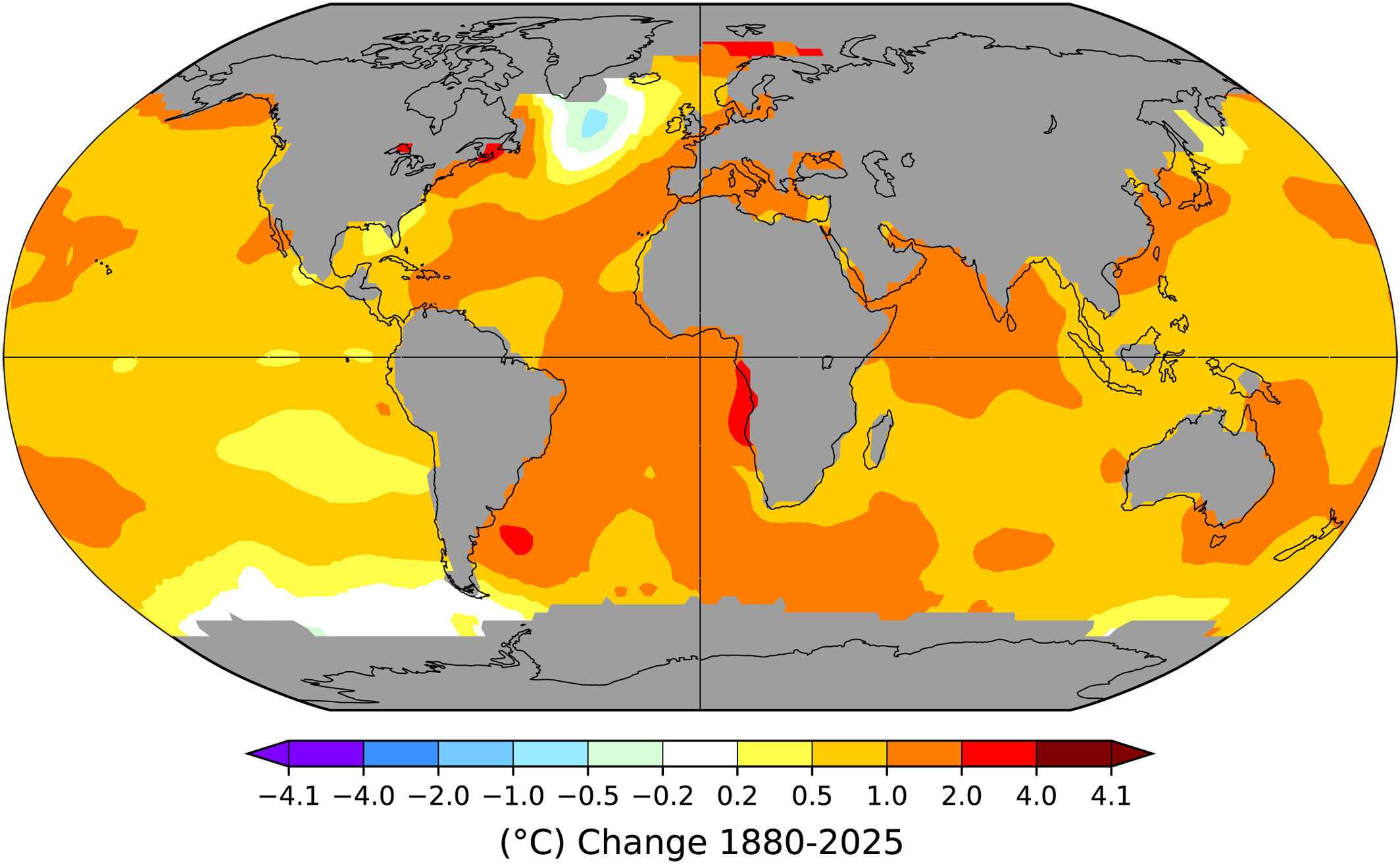
To find out, scientists at the Potsdam Institute for Climate Impact Research used direct weather observations from satellites, buoys, and ships to track temperatures across the Atlantic, combined with established climate models.
Their findings suggest that the patch's cooling isn't just occurring at the surface, but deep below the peripheral waves within the top 1,000 meters (3,280 feet) of the water column. As such, the cooling can't purely be explained by increasing surface heat loss, but instead points to a decline in lateral heat transport.
Nearing tipping point?
This, the study suggests, would neatly tie into the idea that the AMOC is weakening and could be heading towards a tipping point that could culminate in its collapse.
“Our analysis supports the interpretation of the observed ‘cold blob’ as a sign of a weakening AMOC,” wrote the study authors.
If the idea of the AMOC collapsing sounds faintly familiar, it's a key premise of the 2004 blockbuster The Day After Tomorrow, in which the Northern Hemisphere is suddenly plunged into a devastating ice age nearly overnight. Of course, it's a Hollywood movie, and yes, the timeline is wildly exaggerated. But strip away the disaster-movie sensationalism, and it's not as far-fetched as it might first appear.
A real AMOC collapse would bring extreme cooling to Europe, send sea levels surging along the US East Coast, and unleash chaos on global rainfall and weather patterns. The damage could be catastrophic, just on a slightly less cinematic timescale than the film shows.
Scientists disagree on whether the AMOC is approaching its “tipping point”, and they quibble over the exact extent of its doom. While the latest study doesn't directly weigh into these big questions, it does boost the troubling idea that something strange is stirring in the Atlantic.
“Given the well-established existence of a tipping point of the AMOC, as well as recent studies finding a range of different 'early warning signals' of the ocean circulation approaching such a tipping point, the strong evidence for a weakening AMOC is a serious concern for society and policy,” the paper concludes.
The new study is published in the journal Geophysical Research Letters.